Asia · Solo Travel
Solo traveller · 20 min read
Region Uttar Pradesh, India |
Trip length 3 days, Ayodhya Dham |
Travel style Solo, with a returning local guide |
Ayodhya Dham genuinely needs 3 full days, Ram Janmabhoomi and Hanuman Garhi in the centre of town, Makhauda Dham and Chhapaiya on the outskirts, and Guptar Ghat and Gumnami Baba’s Samadhi further out still. One thing worth knowing before you go: there is no paid VIP darshan pass, the free Sugam Darshan slot booked through the official portal is the only legitimate system, and every “VIP pass” agent near the station is running a scam.
- Hanuman Garhi and why it comes first
- Ram Janmabhoomi: the real darshan process
- Dharam Path’s murals and a proper Ayodhya breakfast
- Makhauda Dham and Chhapaiya: two birthplaces, two traditions
- Dashrath Mahal and evening aarti on the Saryu
- Baati Chokha and Raja Dashrath’s last rites
- Guptar Ghat and Gumnami Baba’s Samadhi
- Kanak Bhawan and Ram Ki Paidi
- Practical info at a glance
- Common questions
I first filmed in Ayodhya Dham six years ago, and coming back this time, I genuinely couldn’t reconcile the two visits in my head. Wide two-way roads where there used to be narrow lanes, brands and malls that weren’t here before, a level of overall cleanliness that stood out immediately. River Saryu, mentioned throughout the Ramayana and the Vedic texts, runs right past Ram Ki Paidi, and the evening river worship happening along its banks now takes place at several points rather than the single spot I remembered from before.
Hanuman Garhi and Why It Comes First
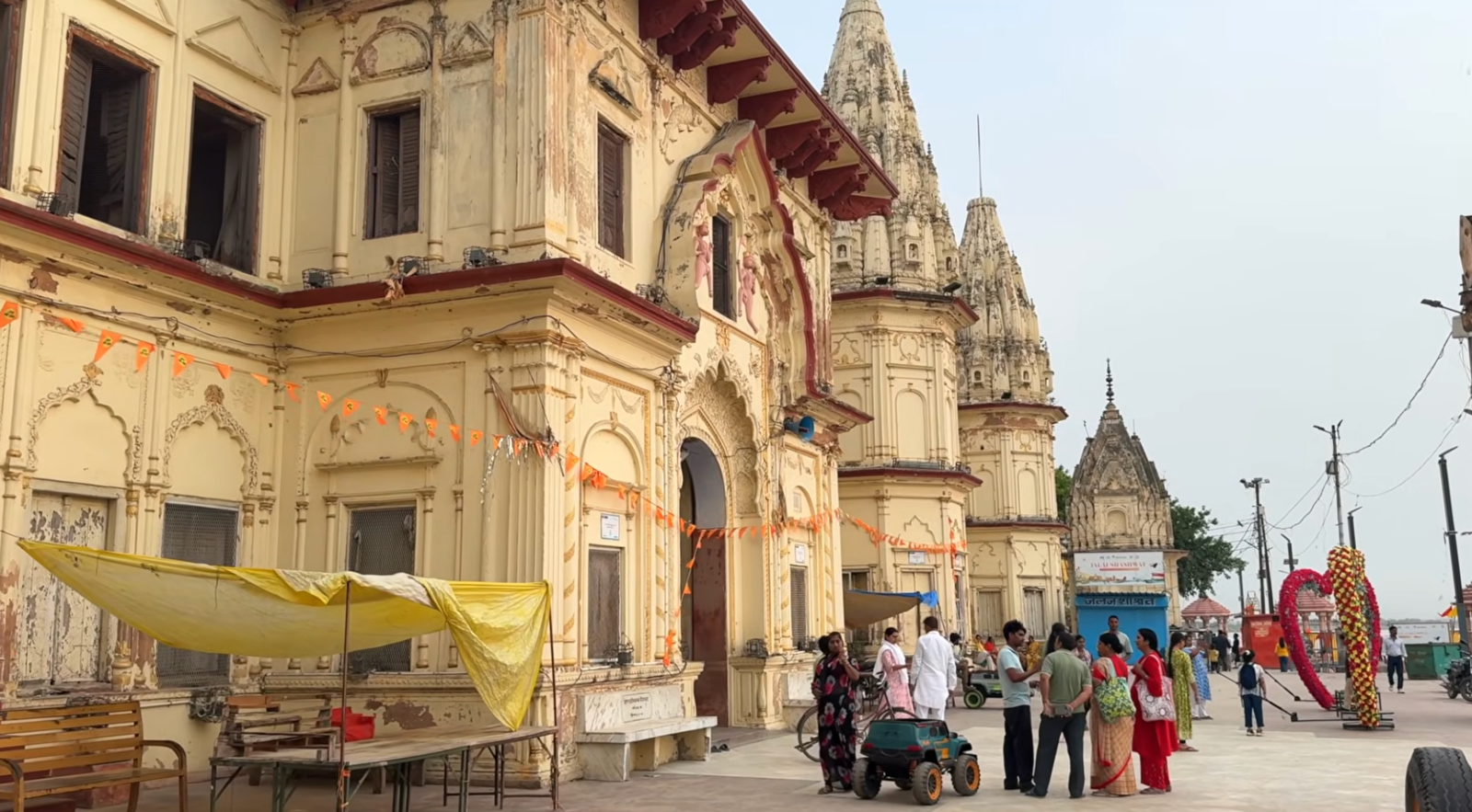
Sri Ram Janmabhoomi and Sri Hanuman Garhi both sit within a 2km radius of each other, and Lata Mangeshkar Chowk, marked by a 40-foot, 14-tonne Veena built in her memory, sits right between them, close to where Ram Path (13km, running toward the Cantonment area and Garuda Gate) and Dharam Path meet. I started at Hanuman Garhi specifically, on the local tradition that any Ayodhya visit should open there. According to the story, when Lord Rama was preparing to leave for Vaikuntha, Hanuman asked to go with him, and Rama instead named him King of Ayodhya, with a condition, anyone visiting Ayodhya completes their pilgrimage only after paying respects to Hanuman first. It’s said devotion to Hanuman offers protection from harm and brings peace and prosperity to those who understand what he represents.
I met Pandey ji again here, the same guide who’d walked me through Ayodhya six years ago, a genuinely nice reunion, and he stayed with me for the rest of the day.
Ram Janmabhoomi: The Real Darshan Process
Here’s the single most important practical thing in this whole guide: there is no paid VIP darshan pass at Ram Janmabhoomi Mandir. What everyone calls the “VIP pass” is actually Sugam Darshan, a free, slot-based system, along with separate free passes for the Mangal, Shringar, and Shayan Aartis. Every one of these is booked through the official Shri Ram Janmabhoomi Teerth Kshetra Trust portal, and no other website or agent is authorised to charge for it. Fake booking sites and agents near the railway station promising a “guaranteed VIP ticket” for anywhere from ₹500 to a few thousand rupees have multiplied as the temple’s popularity has grown, and every one of them is a scam. If any site shows you a payment page for the pass itself, close it.
A free wheelchair is available at the Yatri Seva Kendra, with an assistant charging ₹150 per person, one companion allowed per wheelchair user. Anyone over 70 can get a senior-citizen pass offline with an Aadhar card and an accompanying attendant. Before entering, shoes go into a deposit counter, phones and other items into a shoulder bag, and everyone goes through a security frisk. From the main gate, the idol of Lord Rama is visible from 70 to 80 metres away as you move closer, and I spent 15 to 20 minutes inside, eventually viewing it from about 30 feet. Ram Darbar, with idols of Rama’s three brothers and Goddess Sita, sits on the first floor. A free pass also gets you into Sapt Mandapam, seven smaller temples most visitors don’t even know exist, worth asking about specifically since it’s easy to miss.
On accommodation near the temple: Birla Dharamshala, directly opposite, only takes bookings offline, in person, specifically because online booking scams have targeted it before. Worth knowing before you assume you can reserve it remotely.
Dharam Path’s Murals and a Proper Ayodhya Breakfast
Dharam Path is lined with mural paintings worth genuinely slowing down for, the argument between Kumbhakarna and Vibhishana, Rama’s fight with Kumbhakarna, Indrajit striking Lakshmana mid-battle, and Hanuman killing the demon Kalanemi. That last one connects to a spot 100km from Ayodhya called Bijethua Dham, where the killing itself is said to have taken place, ferocious enough that Kalanemi went straight to hell.
Maurya Mishtan Bhandar does an excellent Kachori-Sabji, mildly spiced aloo curry with kachori and a layer of curd on top, and the crowd there tells you everything about how good it actually is. I also gave in to fresh Jalebi despite generally avoiding sweets these days, served here between two layers of curd in a mud bowl, sour against sweet, a combination that either clicks for you or doesn’t, though I already knew I liked it from a previous visit.
Makhauda Dham and Chhapaiya: Two Birthplaces, Two Traditions
Suraj Mishra ji, a local resident, joined me for the outskirts, and 40 minutes out is Makhauda Dham, less known than Ayodhya itself but, by local tradition, where the Ramayana’s story actually begins, before Rama’s birth. This is where King Dasharatha is said to have performed the Putrakameshti Yajna a thousand years ago with the help of Singh Rishi, and where the fire goddess, moved by the ritual, gifted Kheer that Dasharatha’s three queens ate to be blessed with four sons, Kaushalya bearing Rama, Sumitra bearing Lakshmana and Shatrughna, and Kaikeyi bearing Bharata. I studied the Ramayana in school 38 years ago, and standing at the actual place these stories point to was a genuinely different kind of experience than reading them ever was.
Thirty minutes further, Chhapaiya village is where Lord Swaminarayan was actually born, a fact far fewer people know than the Akshardham temples in Delhi and Gujarat built in his honour. The house he was born in, his childhood name Ghanshyam Maharaj, sits within the temple complex here, along with idols of his parents and of Lord Krishna, Swaminarayan being considered a form of Krishna. The site also functions as accommodation, AC rooms running around ₹3,000 with meals included, bookable by calling ahead.
Dashrath Mahal and Evening Aarti on the Saryu
Dashrath Mahal, King Dasharatha’s original royal residence and where Rama and his brothers grew up playing, is a short 5 to 7 minute walk from Hanuman Garhi, prayer ongoing inside when I visited. The evening Saryu aarti now runs at 7pm on paper but started closer to 7:30 the evening I went, and unlike my last visit, it’s spread across several ghats now rather than concentrated at one, Kacha Ghat giving a feel genuinely reminiscent of Banaras. The night view back at Lata Mangeshkar Chowk, properly lit, is worth the walk back through too.
Baati Chokha and Raja Dashrath’s Last Rites
Pallavi Bati Chokha does a genuinely excellent version of this Purvanchal specialty, two kinds of Baati, one stuffed with roasted gram flour (Sattu), one with paneer, both deliberately hard from wood-fire cooking, served with Chokha, roasted potato, tomato, and brinjal mashed together with mustard oil and chilli. The Sattu version edged out the paneer for me, and the mustard oil hit the same way a good Kumaon-style mustard raita does. The place itself leans into a village-life theme, a hut-style roof, an indoor well, genuinely transporting for a meal.
Raja Dashrath Samadhi Sthal, 30 to 40 minutes out, is where Dasharatha’s last rites were performed, and, by tradition, no one else’s rites have been conducted on this specific ground since, making it one of the purest sites in Ayodhya. During Rama and Lakshmana’s exile, Bharata specifically requested his father’s rites happen separately from anyone else’s. Ancient weapons here remain unrusted with no clear record of their true age, footprints of the four brothers and Guru Vashistha mark the ground, and the temple holds what’s said to be the only existing idol of Dasharatha, alongside Bharata, Shatrughna, and Guru Vashistha. A Shani idol here is unusual too, eyes fully closed rather than the sideways glance Shani is typically worshipped from, meaning devotees can approach it directly from the front.
Guptar Ghat and Gumnami Baba’s Samadhi
A sudden storm on the way to Bharat Kund, Nandigram uprooted enough trees to block the road entirely, and we rerouted rather than force it, saving that stop for the next day. Guptar Ghat, an hour and a half out, is where tradition holds Rama took Jal Samadhi in the Saryu after his reign ended, four or five uniformly coloured temples with genuinely ancient architecture, including one with idols of Rama, Lakshmana, and Sita. A river-front walk here connects, by water, roughly 8km back to the main Ayodhya ghat, with a cruise to Naya Ghat under construction that will eventually make that connection directly. Evening aarti happens here too, on the riverbank.
Gumnami Baba’s Samadhi, nearby, is one of the more genuinely fascinating and unresolved stories in Ayodhya. Baba, who died in 1985, spoke so rarely that “Gumnami,” meaning anonymous, became his name. A persistent theory holds he was actually Netaji Subhas Chandra Bose, living out his later years under an assumed identity, grown beard and near-silence included. Handwriting analysis reportedly matching Bose’s own, along with family photographs found among his belongings, support the theory; the counterargument is that Bose, in independent India, would have had no clear reason left to hide who he was, having already taken far greater risks earlier in life. Both readings have genuine support, nothing here is settled, and different people hold different views. What isn’t in question is that Gumnami Baba himself was a serious, genuine ascetic, whoever he actually was.
Kanak Bhawan and Ram Ki Paidi
Before Gumnami Baba, an evening tea and pakora stop turned into meeting Shashank and Manish Dubey, two Ayodhya-based content creators running ayodhyahub and ayodhyasarkar, and a stop at Surya Kund rounded off that night, ₹30 entry for a light-and-sound show themed around the ideals of Ram Rajya governance, tied to the legend of Surya Dev descending in human form to teach Rama how to rule after Dasharatha’s death, at the exact spot his chariot is said to have stopped. The current idol here is 300 to 400 years old, commissioned by King Darshan Singh, with renovation work ongoing.
Kanak Bhawan, my final morning, was gifted to Sita by her mother-in-law Kaikeyi, and functions as Rama and Sita’s Rang Mahal, three pairs of idols installed in the sanctum, with a Krishna-era renovation attributed to Lord Krishna himself, one reason it’s counted among Ayodhya’s top three temples. A distinctive Hanuman idol here comes with a local story, not found in any scripture, that Hanuman, told by Rama’s mother he was too old to share a room with the others, wept, and has been present at Kanak Bhawan ever since, a devotional tale rather than a textual one, worth taking exactly as that. Note that Kanak Bhawan keeps different hours than most other temples, many of which close between 12pm and 4pm.
My original plan included Bharat Kund again, but with an afternoon train and a visit already done on a previous trip, I let it go this time and instead walked the riverbank from Ram Ki Paidi, proper ghats built along about a kilometre of the Saryu, temples lining the walk, right through to where Guptar Ghat connects on foot. Standing on the bridge here, it genuinely reminded me of Har Ki Paidi in Haridwar, and this same stretch is where the annual Deepotsav festival of lights is held.
Practical Info at a Glance
| Ram Mandir darshan | Free Sugam Darshan and Aarti passes, official portal only. No paid VIP tier exists, anyone charging for one is scamming you |
| Wheelchair assistance | Free wheelchair, ₹150/person for an assistant |
| Chhapaiya accommodation | ~₹3,000 AC room, meals included |
| Temple hours | Most Ayodhya temples close 12pm–4pm; Kanak Bhawan keeps separate hours |
Common Questions
Is there really a paid VIP darshan pass at Ram Mandir?
No. This is one of the most common scams targeting Ayodhya visitors. The real system is Sugam Darshan, free, slot-based, booked only through the official Shri Ram Janmabhoomi Teerth Kshetra Trust portal. Anyone charging money for a “VIP pass” is not legitimate.
How many days do I need in Ayodhya?
Three full days covers the central sites (Ram Janmabhoomi, Hanuman Garhi, Dashrath Mahal) plus the outskirts (Makhauda Dham, Chhapaiya, Guptar Ghat, Gumnami Baba’s Samadhi) without rushing.
Is Chhapaiya worth visiting?
Yes, if Swaminarayan tradition interests you at all. It’s the actual birthplace, far less visited than the Akshardham temples, and roughly 30 minutes past Makhauda Dham.
What should I eat in Ayodhya?
Kachori-Sabji with curd at Maurya Mishtan Bhandar, Jalebi with curd if you’re willing to try the combination, and Sattu-stuffed Baati Chokha at Pallavi.
Planning something similar?
Email your route and I’ll reply with honest, first-hand advice, no fluff.
Ask Dhruval →