Asia · Solo Travel
Solo traveller · 16 min read
Region Kumaon, Uttarakhand, India |
Trip length 3 days, Dantu to Panchachuli Zero Point |
Travel style Solo, homestay-based |
Darma Valley and the hike to Panchachuli Zero Point is one of the best treks I’ve done, genuinely in my personal top three. It’s moderate, not technical, but the 4:30am start through bear-inhabited forest and the 3 hour 45 minute climb to base camp mean it rewards fitness and a guide over bravado. You don’t need an Inner Line Permit for the base trek itself, only if you continue further toward Sipu or Charkha Hya Top.
Nothing quite prepares you for waking up in a Bugyal in Darma Valley with the Panchachuli Range laid out in front of you, three of the five peaks completely clear, the other two still tucked behind cloud. Panchachuli means five peaks, and the Nyola River running below the bridge nearby traces its whole path back to the Panchachuli Glacier itself. I could genuinely have stood there all morning and not left.
Getting There and the Darma Valley Permit Situation
Dharchula is your last real stop before things get remote, fuel up, withdraw cash, and stock up here, because none of that is reliably available once you’re past it. Worth clarifying, since it trips people up: an Inner Line Permit is not mandatory for the standard Darma Valley trek up to Dugtu and the Panchachuli Zero Point hike itself, ITBP checkposts at Sela and Baling do register every trekker regardless, so carrying one anyway avoids any friction. Where the ILP genuinely becomes mandatory is if you push further, toward Sipu village or up to Charkha Hya Top, both of which sit deeper in the valley. It’s issued free or for a nominal fee, same-day, at the SDM office in Dharchula, in person only, no online option as of 2026.
Dantu and Dugtu: Two Villages, Two Views
Breakfast at the homestay was Ogal Roti, a buckwheat chapati served with two dips I’d never tried before, one made from Sea Buckthorn, sharp and sour, and one from Timur, which is Sichuan pepper, mixed with tomato and a local ingredient called Gurnu, known elsewhere as Kala Jeera, which completely shifts the dip’s flavour. Balanced with a little chilli against the sourness, and paired with Mattha, the local buttermilk, it’s a genuinely proper start to a mountain morning.
Dantu village sits 2km from where I was staying, walkable, and villages up here are named by family surname, Dugtal, Sipal, Datal, all clustered around this part of the valley. About 90% of the houses are built from stone, wood is used sparingly, and I got invited into one home over 200 years old, its ceiling woodwork darkened with age but still genuinely striking, a small hole in the kitchen ceiling the only ventilation for the central stove. The family had no idea exactly how old the village itself was, just that it long predates anyone currently living there.
The choice between staying in Dantu or Dugtu genuinely changes your experience. Dugtu puts you closer to the river and closer to the start of the Zero Point hike. Dantu gives you the clearer, more direct view of the Panchachuli Range itself, four of five peaks visible without having to go anywhere else to see them.
Homestays and What They Actually Cost
Most stays here run ₹1,200 to 1,500 per person. Bhojpatra Kutir, right by where I stayed, charges ₹1,500 for a dorm bed, or ₹5,000 to 6,000 for private rooms with an attached Western-style bathroom. Electricity is genuinely limited this deep in, solar-powered DC through the day, a generator switched on in the evening and cut off by 11pm, so plan your charging around that. The Himalayan Blue Sheep stay near Dantu wants ₹15,000 for five people including breakfast and dinner, with river and Panchachuli views included, though mine wasn’t kept in great shape on a same-day check-in. Apno Ghar Homestay in Dantu, further up the hill, was warmer in every sense, ₹1,500 per person with an attached bathroom, ₹1,000 for rooms without, both including breakfast and dinner, with the owner offering evening snacks and tea unprompted and asking about my lunch plans without me bringing it up. The small things matter more than you’d think, this far from anywhere.
A Detour to Tidang I Hadn’t Planned
I met a local rider, Sandeep ji, in Dantu, a Himalayan biker heading the same direction toward a check-post about 7km on, and he offered me a pillion ride. We stopped half a kilometre before the post for a view that stopped me completely, cloud shadows moving across the mountains in real time, like a slow-motion time-lapse playing out in front of you. Sela marks the start of Darma Valley proper, Sipu is the last village, 25km further in, which gives you a sense of just how large this valley actually is.
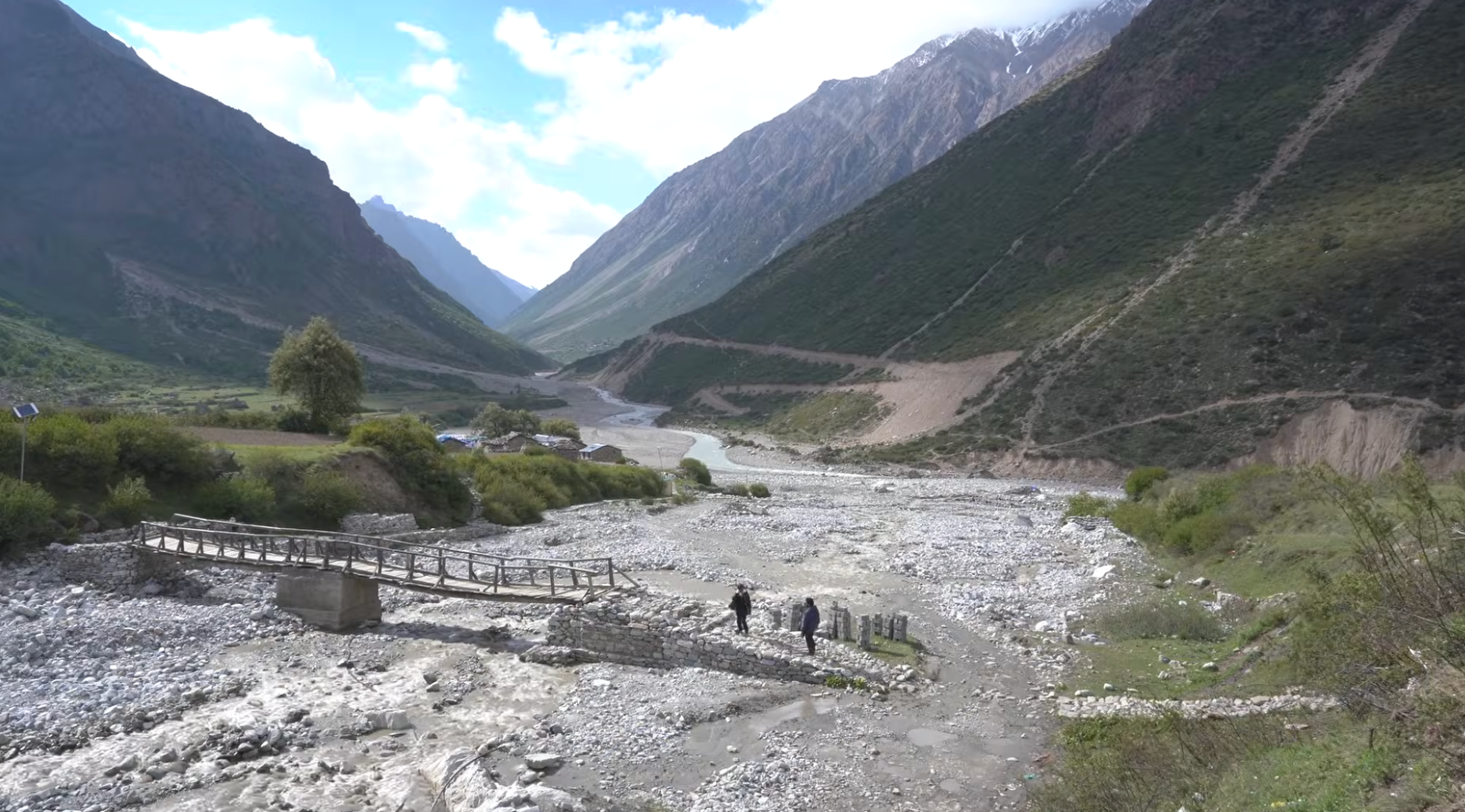
We continued 4km to Tidang, terraced grasslands stepping down the slope, and this is as far as you can go without a permit. Roads are being built from here toward Adi Kailash, walkable only for now, though vehicle access is expected to eventually connect this route as a genuine second option into the region. Sandeep ji then pointed me toward a wooden bridge and a stretch of the Dhauli Ganga riverbed that wasn’t part of my original plan at all. Boulders, the river running through them, the whole scene visible from a completely different angle than anything I’d seen from higher up. I sat there for a good ten minutes just listening to the water. Sometimes the best part of a trip is the thing nobody put on the itinerary.
Is the Zero Point Hike Actually Safe?
Genuinely, yes, with real caveats worth taking seriously. The route passes through dense forest known to have bears, which is exactly why groups start at 4:30am rather than the 3am some plan for, moving through in a group during the safer window. Beyond the animal risk, certain green sections of the trail carry landslide risk too, and a guide who actually knows the terrain matters here, not every spot that looks like a good photo stop is one. The trek itself is moderate rather than technical, no climbing gear needed, but altitude and a genuine 3-plus-hour climb mean fitness matters more than experience. Go with a guide, stick to the group, and this is a completely manageable, non-technical trek that happens to pass through genuinely wild terrain.
The 4:30am Hike to Panchachuli Zero Point
Snow was still catching moonlight when we set off from Dugtu, and I was breathless within the first 30 metres, elevation making itself known immediately. Two of the five Panchachuli peaks appeared first, motivation enough to keep climbing as the rest gradually revealed themselves. The view kept shifting every 400 to 500 metres, Dantu visible below us at one point, the whole thing feeling less like a hike and more like watching the valley from a helicopter.
Ten minutes into the dense forest section, genuinely the most unfamiliar walking I’ve done, aware the whole time that this was real bear territory, sunlight barely reaching the forest floor. Then, without much warning, all five peaks at once, close enough to feel entirely new even after everything I’d already seen of the range from below. Base camp came after a 2.5km climb, a spot KMVN used to run organised camping at before shutting it down over animal risk. From there, another 3km with real incline, and I counted seven waterfalls along the way, possibly an eighth I couldn’t fully confirm without binoculars.
This sits genuinely among my life’s top three treks. Gaumukh is first. I’m still deciding what earns third place, but this one has a real claim to second.
Three hours and forty-five minutes after starting, we reached Zero Point itself, the glacier and the grass line’s edge, all five peaks laid out directly ahead, though the fourth and fifth carried some cloud cover. I could count all seven waterfalls clearly from here, an eighth genuinely visible too, all of them feeding into the Nyola River below. Standing at the moraine, the actual river hidden beneath boulders and deposited mud, it’s hard not to think about how fast this landscape is changing. The glacier has visibly retreated, and the crack formations forming now suggest that in another two to three years, reaching this exact spot might not be possible the way it is today. What I was standing on will likely be snow-covered moraine before too long.
We’d started at 4:30am and reached Zero Point by 8:15, spent about ninety minutes taking it in before the sun got too harsh to justify staying longer, and made the descent in about 90 minutes without stopping to film. If you’re fitter than us, the whole climb can be done in about 2.5 hours instead of the nearly 4 it took our group.
A Proper Kumaoni Meal
I’d specifically asked for traditional food back at the homestay, and what came out was genuinely one of the more memorable meals of this entire trip. Local Rajma, smaller than what you’d find elsewhere, alongside a millet dish that resembled Bhatt ke Dubke but built from a completely different grain, a radish salad, curd-based jholi, and a dish called Jaadu, five or six types of flour roasted together, then cooked in water and finished with ghee, served in a wooden bowl. It’s a genuinely labour-intensive dish, soaked, hand-ground, and simmered for an hour and a half to two hours, and homestays here need a full day’s notice if you want it.
A local green vegetable, juicy and chewy, spiced simply with salt and chilli, uses Gandrayani, an herb specific to this part of Kumaon that’s traditionally added to help digestion after a heavy meal. The buttermilk here uses Jambhu, a herb I didn’t recognise by taste going in but liked immediately. And the jholi genuinely outdid every version I’ve had, including in Himachal Pradesh, a distinctly local sourness that I don’t think travels outside this valley. If you only try one thing, make it the Rajma, it’s rightly famous across this part of Uttarakhand even though people associate the bean with Jammu.
A standard local lunch, dal, rice, and one dish, runs about ₹250 per person, and nothing here is pre-cooked, everything’s made fresh within an hour of ordering. The elaborate spread I had, the full traditional meal described above, cost ₹450 per person. Worth knowing before you rely on your phone out here: Jio works for calls but not data this deep into the valley, and a BSNL tower has been installed but wasn’t yet activated for internet at the time, expected to come online within a matter of months, so check current status before assuming you’ll have signal.
Practical Info at a Glance
| Inner Line Permit | Not required for the base Darma Valley/Zero Point trek; mandatory only if continuing to Sipu or Charkha Hya Top. Free/nominal fee, same-day, SDM office Dharchula, in person only |
| Homestay cost | ₹1,000–1,500 per person typical, including breakfast and dinner |
| Zero Point hike | 2.5–4 hours depending on fitness; starts pre-dawn for bear safety |
| Connectivity | Jio calling works, data unreliable; check current network status before relying on it |
Common Questions
Do I need an Inner Line Permit for Darma Valley?
Not for the standard trek up to Dugtu and Panchachuli Zero Point. You only need one if you’re continuing further, toward Sipu village or Charkha Hya Top. It’s free or nominally priced and issued same-day at the SDM office in Dharchula.
Is the Panchachuli Zero Point hike dangerous?
It’s a moderate, non-technical trek, but it passes through forest with real bear presence, which is why groups start before dawn. Go with a guide who knows the terrain, and it’s a genuinely manageable, worthwhile hike.
Should I stay in Dantu or Dugtu village?
Dugtu puts you closer to the river and the start of the Zero Point hike. Dantu gives you the clearer, more direct view of the Panchachuli Range itself.
What should I eat in Darma Valley?
Ask your homestay for a traditional Kumaoni meal a day in advance. Local Rajma, Jaadu, and the curd-based jholi are all worth specifically requesting.
Planning something similar?
Email your route and I’ll reply with honest, first-hand advice, no fluff.
Ask Dhruval →