Asia · Solo Travel
Solo traveller · 17 min read
Region Terai, Uttar Pradesh, India |
Trip length 4 days, Dudhwa to Pilibhit |
Travel style Solo |
Dudhwa, Kishanpur, and Pilibhit together make one of India’s most underrated wildlife corridors, real tiger and rhino sightings without the crowds of Ranthambore or Corbett. Dudhwa is your best shot at both tigers and rhinos in one safari, Kishanpur is the birding and deer specialist, and Pilibhit adds genuinely unusual canal-engineering history on top of the wildlife.
Dudhwa National Park at 5:45am, with my guide Mr. Rana and driver Krishna ji, is where this whole safari run through Uttar Pradesh’s Terai belt started, and within the first hour I’d already spotted a one-horned rhino across the water. Rhinos in the wild show up in exactly three places in India, Assam, West Bengal, and here in Uttar Pradesh, which is part of what makes Dudhwa genuinely unusual as a destination.
Dudhwa’s Rhinos, and a Tiger Stalking Behind Them
The watchtower gives the best first read on the park, elephant grass stretching out across genuine grassland, with an enclosure area at Salukapur Chowki holding rhinos originally brought in from Assam. There’s a small cafeteria here serving tea and pakora if you need a break, and the elephant camp runs its own safari, three elephants into the enclosure each morning, or four gypsies allowed in during the evening instead.
Worth updating with current numbers: at the time of my visit, the enclosure held roughly 4 rhinos outside and 32 inside, but Dudhwa’s most recent census, from July 2026, puts the total population at 53, up from 51 the year before, 17 males, 25 females, and 11 sub-adults and calves. The rehabilitation programme here is a genuine conservation success story.
We ended up spotting seven rhinos together in the water at once, cooling off from the heat, a mother and her male calf among them, and the rest identified individually by name and ID, Vijay the male, Suheli, Rajshree, Sumindra among the females. Rhinos here can live up to a century, feed mostly on grass, and despite the calm scene, they’re capable of attacking a vehicle if provoked, and a tiger can, and does, attack a rhino under the right circumstances. As if on cue, mid-sighting, a tiger appeared moving through the shrubs directly behind the rhinos, close enough to feel genuinely tense, before it moved off and the jungle’s usual alarm calls picked up again once it had passed.
Dudhwa itself breaks down roughly as 20% grassland, 10% water bodies and wetlands, and 70% woodland, and the Nepal border sits just 25km away, closer still, about 5km, from the Katarniaghat side of the reserve.
A Tiger and a Rhino, Four Metres Apart
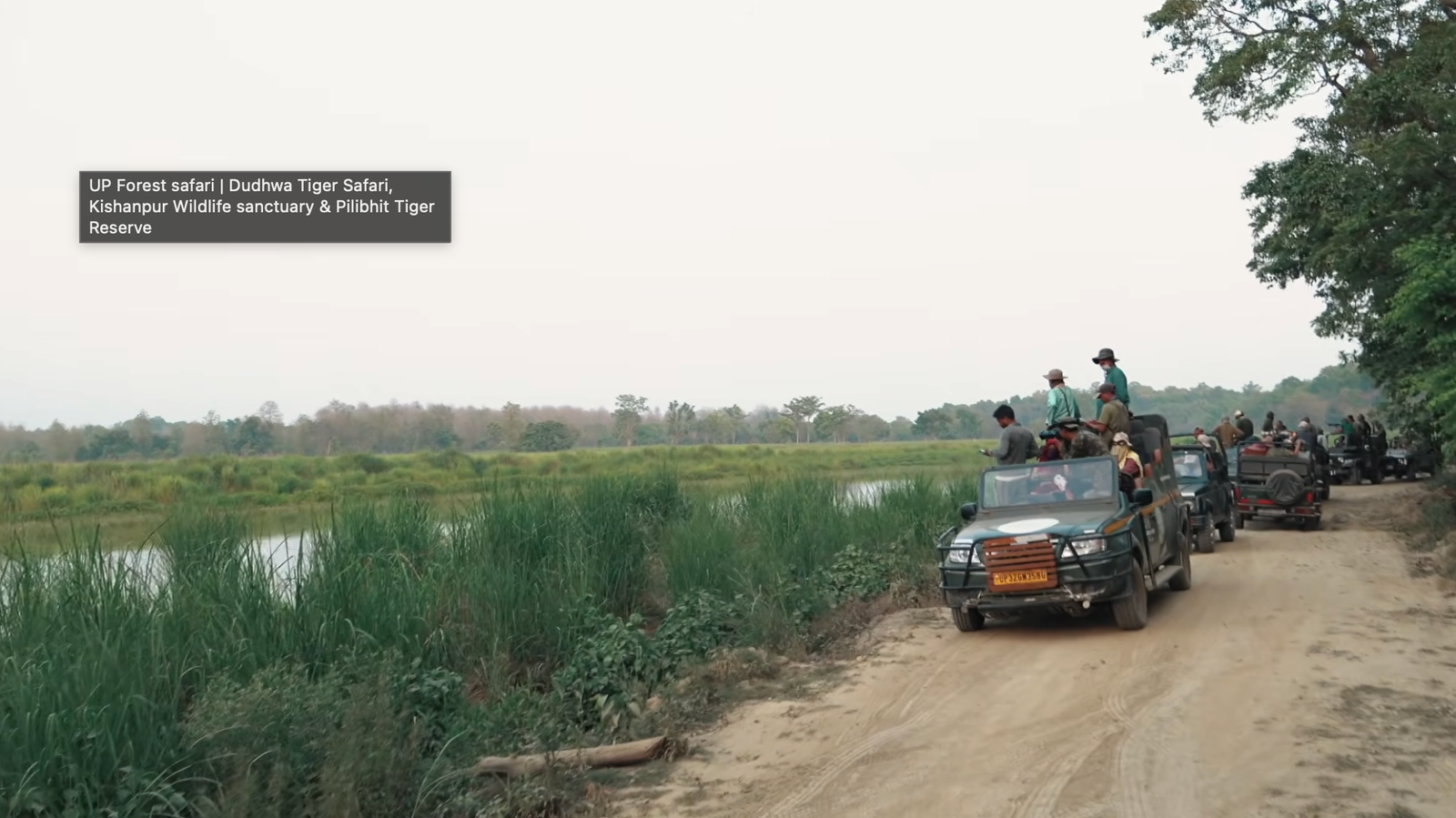
A different day, a different guide, Brijlal ji this time with driver Ajay, on a route past a British-era railway track under consideration for realignment. This safari delivered the actual highlight of the whole trip. We found a male tiger resting in the water, easier to make out clearly through binoculars than with the naked eye, cooling its body the way tigers do in the heat, with 10 to 15 other gypsies gathered around waiting to see if it would move.
A rhino walked to within four metres of a resting tiger, and neither animal reacted. I’ve never seen anything like it, before or since.
Neither animal changed position the entire time, the tiger watching the rhino cross past without any sign of aggression, our guide explaining that a lone tiger genuinely can’t take down a rhino on its own, which is likely exactly why neither one felt the need to react. That particular rhino was wearing a radio transmitter collar, one of eight rhinos recently released from the enclosure into the open forest as part of the same conservation programme behind the population growth mentioned above. We watched the tiger sit motionless in the water for 45 minutes before we had to leave for the 6:30pm exit gate.
Termite Mounds, and the Corridor That Connects It All
The termite mounds scattered through Dudhwa are genuinely worth stopping for. Hard enough that you can barely cut into one, they take roughly a decade to build, hollow inside with small internal chambers, home to worker, labourer, and soldier termites along with a king and queen, the queen solely responsible for laying eggs while workers handle repairs using mud and larvae. Termite saliva hardens the structure enough to shed rainwater entirely, and sloth bears are one of the few animals capable of breaking in, clawing through slowly to reach the termites inside. The forest itself runs mostly Sal trees with some Sagwan mixed in, spread across 680 square kilometres core area, 2,210.77 including the buffer zone.
Huts here are bookable through the UP Tourism website, though there’s no mobile network on site, worth planning around. The bigger picture is what makes this region genuinely special: Dudhwa Tiger Reserve is actually three connected parts, Katarniaghat, Dudhwa itself, and Kishanpur, and Kishanpur in turn connects to Pilibhit Tiger Reserve, which links further still to Nandhaur and Corbett. Tigers, elephants, rhinos, leopards, sloth bears, and a huge range of birds move through this entire corridor, and connectivity into the region, roads and rail both, has genuinely improved in recent years, though it remains far less crowded than better-known parks like Ranthambore or Bandhavgarh.
Kishanpur: Deer, Storks, and a 200-Year-Old Banyan
Kishanpur Wildlife Sanctuary spans 205 square kilometres on the banks of the River Sharda, and the safari here cost ₹3,360 plus a ₹177 camera fee. Fresh claw marks on a tree turned into a proper lesson in tiger behaviour, scratches and urine spraying both used for scent marking, a way for tigers to signal territory and read each other’s presence without ever meeting directly, less common here than at Dudhwa but genuinely fascinating once explained.
A herd of Swamp Deer, known locally as Daldali Hiran and Uttar Pradesh’s state animal, stood in water together, males distinguishable by antlers, females without. Five of India’s eight deer species live in this stretch alone. A pair of Black-necked Storks stood nearby, and through binoculars the whole scene felt closer than it actually was. This backwater belongs to the River Sharda, called the Mahakali once it crosses into Nepal, the same river system that runs through the Kumaon region further north. A Banyan tree here, over 200 years old, is the kind of thing you genuinely don’t encounter in a city anymore, its branches propped up by their own aerial roots for support. November and December mark peak season here, and Melani, 13km away, is the nearest railway station, a weekly service from Mumbai, daily from Lucknow, though there’s no direct route from Delhi, you’ll go via Bareilly. I didn’t spot a tiger on this particular visit, but the birding and deer sightings alone made the day worthwhile.
Pilibhit’s Canals and the Seven Falls
The Terai belt itself is essentially the floodplain of the Himalayan rivers running from the Yamuna to the Bagmati, genuinely fertile ground thanks to a high subsurface water table that supports sugarcane, rice, wheat, and maize. Safari at Pilibhit ran ₹3,300 plus ₹120, and a ₹300 camera fee covering both entry gates. The Sharda Canal, originating in Uttarakhand and supplying water across Uttar Pradesh, crosses other channels at precise right angles, a genuine engineering feature locals call bifurcation, and this same corridor lets animals move freely between Corbett, Rajaji, and Haridwar with no restriction on their movement.
We counted 25 to 30 peacocks across the safari, two of them mid-dance, and reached Bhimtal, the park’s main animal-gathering point, before continuing 25km to Chuka, a reservoir with a genuinely good sunset, boating available, and UP Eco-tourism stay facilities on site. A newly introduced shared safari option here now lets solo travellers join a group rather than needing a full private vehicle.
The next day’s route ran Route 2, less elephant grass than Route 1, past a genuine curiosity, a second canal running beneath the first via what’s called a syphon, a new sight for me even after seeing plenty of aqueducts elsewhere. From there, Seven Falls, a roughly century-old canal feature, British-built, originally with seven distinct steps, hence the name that’s stuck ever since. A small cafeteria here serves tea, with camps at ₹2,000 and a hut at ₹3,000, and you don’t actually need to book a jungle safari to stay here, a detail most visitors don’t seem to know. Twenty to twenty-five bird species are visible from the site alone, and the weather shifted dramatically within about fifteen minutes on my visit, the grass visibly changing colour as the sky clouded over. No tiger sighting on this leg either, but between the canal engineering and the birdlife, it didn’t feel like a loss.
On the food side, Pappu bhai’s Lassi has a genuine local reputation worth chasing down, alongside Soan Papdi and Tehri if you want to round out the trip with something other than forest-lodge meals.
Practical Info at a Glance
| Dudhwa rhino population | 53 as of the July 2026 census (17 male, 25 female, 11 sub-adults/calves) |
| Kishanpur safari | ₹3,360 + ₹177 camera fee |
| Pilibhit safari | ₹3,300 + ₹120 + ₹300 camera fee (covers two entry gates) |
| Best season | November and December across all three parks |
Common Questions
Where can I see rhinos in the wild in India outside Assam?
Uttar Pradesh’s Dudhwa National Park, alongside West Bengal, is one of only three places in India with wild one-horned rhinoceros. Dudhwa’s population has grown to 53 as of the 2026 census.
Which park should I prioritise, Dudhwa, Kishanpur, or Pilibhit?
Dudhwa for the best combined chance at both tigers and rhinos in one safari. Kishanpur for deer and birding specifically. Pilibhit if you want unusual canal-engineering history alongside the wildlife.
How connected is this region to other tiger reserves?
Genuinely well. Dudhwa’s three zones connect to Pilibhit, which connects further to Nandhaur and Corbett, an unbroken wildlife corridor animals move through freely.
Is a tiger sighting guaranteed on safari here?
No. We saw one clearly at Dudhwa but missed one entirely at both Kishanpur and Pilibhit on the same trip. Go for the full ecosystem experience, and treat a tiger sighting as a genuine bonus.
Planning something similar?
Email your route and I’ll reply with honest, first-hand advice, no fluff.
Ask Dhruval →