Asia · Solo Travel
Solo traveller · 16 min read
Region Kumaon, Uttarakhand, India |
Trip length 3 days, Munsiyari to Dharchula |
Travel style Solo |
Munsiyari is worth two to three days on its own, handloom villages, genuinely excellent Kumaoni food, and a doorway to serious Himalayan trekking. The Milam Glacier trail specifically demands real time and altitude buffer, don’t assume you can day-trip it, the maths on distance and daylight can turn on you fast at this elevation.
- Darkot village and Munsiyari’s handloom trade
- Sarmoli, Jhankara, and Maheshwar Kund
- The Milam Glacier attempt that didn’t quite work
- A shepherd who walks four months without going home
- Keeda Jadi: what it actually is, and the honest legal picture
- Madkot’s hot springs and the ride down to Dharchula
- Practical info at a glance
- Common questions
Munsiyari opens with Nanda Devi Temple, ₹30 entry, and on a clear day, a direct view of the Panchachuli Range’s five peaks. Mine was hazy from a forest fire burning nearby, the best window for a genuinely clear view here is November and December instead. If your timing allows it, the Nanda Devi Yatra itself runs 20 to 22 days in the Garhwal region and is worth building a trip around if the dates line up.
Darkot Village and Munsiyari’s Handloom Trade
Darkot is where Munsiyari’s handicraft tradition actually lives, 215 houses, most of them engaged in handloom weaving, and genuinely worth 3 to 4 hours if you want to see it properly rather than rush through. I was welcomed into one home with Jamir lemon water, a variety that ripens specifically in October and November, sour enough that a little sugar gets added to balance it, the tree itself right there to see.
The wool work here is genuinely impressive, Angora rabbit wool sweaters at ₹2,500, a stole blending 80% Angora with 20% regular wool at ₹1,500, caps at ₹400, gloves and socks from sheep wool. I picked up a cap specifically for the Adi Kailash Yatra ahead of me, and was told, honestly, that all the colours were equally warm, so the choice came down to which one I liked looking at. Every house here weaves, so wandering into any of them tends to get you the same warm welcome, in my case a taste of local Malta juice on top of it.
Sarmoli, Jhankara, and Maheshwar Kund
Saras Bazar, on the way to Sarmoli, is worth a browse for genuine local products, Hing sourced from Dharchula, Jimbhu at ₹50, Haldi, local Rajma varieties, and Bhaang Dana for chutney. One thing worth remembering if it’s relevant to you, Gahat dal soup is a locally recommended remedy for gallstones, warming by nature and traditionally used through the winter months.
Lunch at Mati Cafe in Sarmoli was genuinely one of the standout meals of this whole stretch. Jhankara, made from wild buckwheat leaves, only cooked in April and May when the leaves are still small, sour on its own and lightly seasoned with just salt and chilli. Jambhu and Thoya, used together for the tempering, gave the accompanying Kadhi a completely different character from anywhere else I’ve had it, thick curd, barely any masala, the flavour built entirely around those two ingredients. Thoya, incidentally, is the same herb Darma Valley calls Gurnu, used as a herbal tea across the border in Himachal Pradesh but folded directly into cooking here in Uttarakhand. Mandwa chapati, millet flour cut with a little wheat so it holds together, paired properly with the Jhankara, and a fermented Sea Buckthorn pickle rounded the meal out, something I genuinely hadn’t known was possible to make before trying it.
Sarmoli itself runs 20 to 22 homestays, ₹1,500 to 2,000 per person, and functions as the launch point for a short hike to Maheshwar Kund. Local women were singing traditional songs right at the trailhead as I set off, and about 40 minutes of stone steps, arranged almost like an amphitheatre, later, the Kund itself turned out smaller than I’d pictured, though the climb up mattered more than the destination itself. I ended up joined partway by a couple of subscribers who’d already done the Khalia Top trek that same morning, 4 hours up, 2.5 back down, and skipped it themselves that day purely because forest-fire haze had killed the visibility. They’d budgeted their entire 8 night, 9 day trip, Delhi to Delhi, fuel included, at ₹15,000 per person, genuinely tight, genuinely well-planned.
The Milam Glacier Attempt That Didn’t Quite Work
5:30am start, following the Gori Ganga upstream in the opposite direction. The first 20km are genuinely good road, then it turns unpaved, and we hit an actual mountain traffic jam before reaching the ITBP checkpost, where registration with an Aadhar card is required. From there, the scenery does most of the work, a waterfall, a small glacier visible right from the road, cold enough by 7:45am that a half-sleeve sweater under a full jacket wasn’t quite enough. Breakfast came at a small roadside eatery, paratha with Potato Wadi, carom seeds lifting the flavour, the whole thing cooked in a haze of smoke that looked genuinely hard on the eyes of whoever was working the stove.
Honest account of how this day actually went: by 12:15pm, with 6.5km still ahead at this altitude and the return trip factored in, the math simply stopped working. Reaching Munsiyari safely by nightfall wasn’t realistic if we pushed on, and staying at that elevation overnight without proper arrangements wasn’t a safe alternative either. We made the call to turn back rather than force it, kadhi rice and the views instead of the glacier itself. It’s the kind of decision that’s easy to regret in the moment and obviously right in hindsight, altitude and distance don’t forgive optimism.
A Shepherd Who Walks Four Months Without Going Home
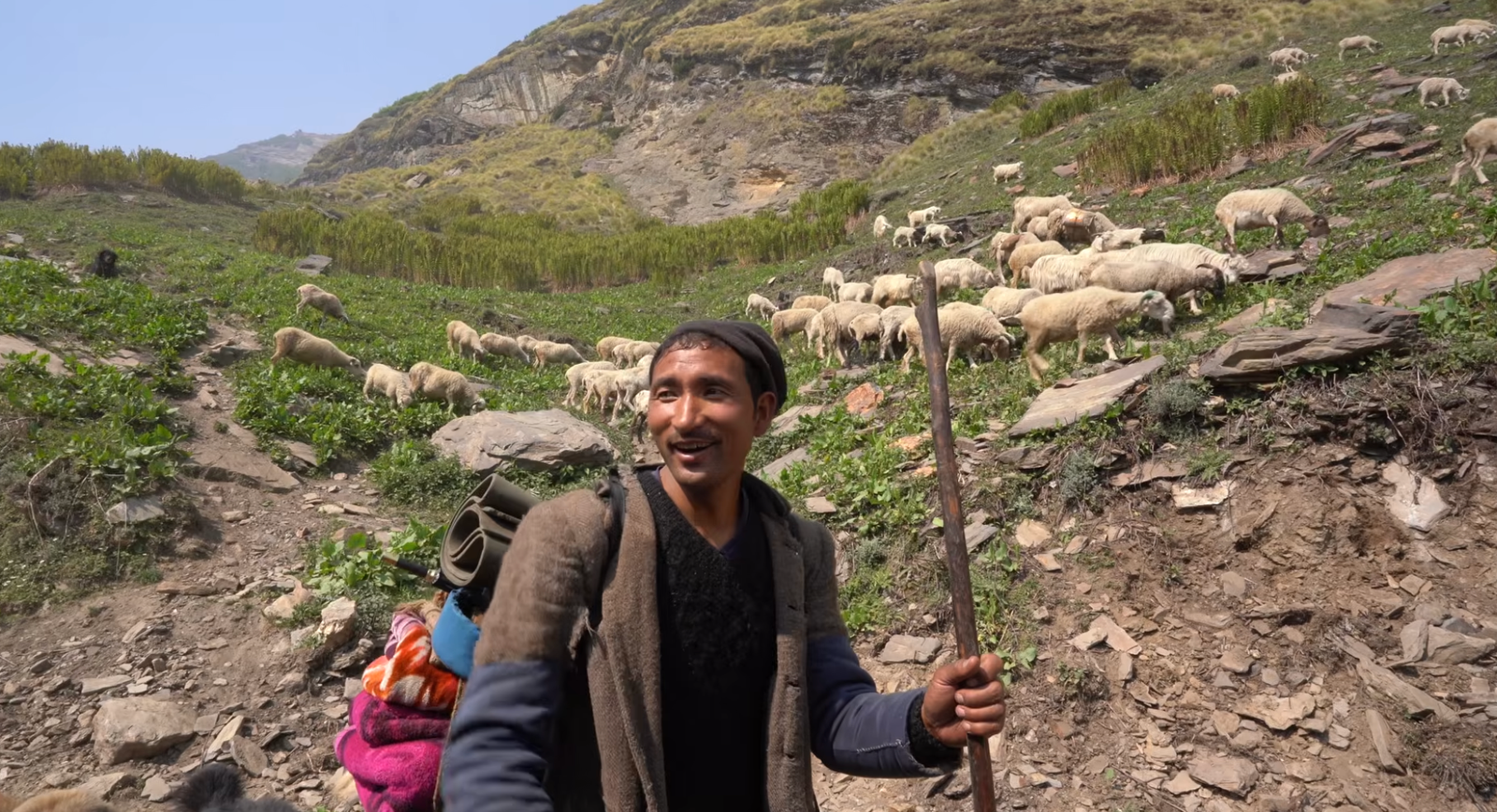
On the way toward Nanda Devi base camp, I met a shepherd moving 300 to 400 sheep on foot, cooking his own food along the trail, the sheep carrying supplies. He’s away from his family in Munsiyari for four months at a stretch, no phone network the entire time, his legs aching by evening most days, some days without a proper meal at all. I’d been carrying a spare pair of shoes and gave them to him on the spot, a small thing against four months of walking, but it felt like the only reasonable response to a conversation like that. Moments like this are the actual reason I keep coming back to places like this instead of just the well-known viewpoints.
Turning back also meant meeting the people who made the day work anyway. A local guide lent his own bike to fetch a car for the return, and while we waited, it turned out he’d watched some of my earlier travel videos, Vietnam among them. Small world, this deep into the mountains. I also crossed paths with Nishant, a fellow travel creator whose Dodra Kwar video I’d genuinely watched twice and shared with my own team to study the shooting style. He’d just come back from Milam Glacier himself that same day, and since I never made it there, his account is the honest source for what that actually looks like: crossing the Gori Ganga, a herd of sheep along the way, the glacier’s meltwater dripping audibly, roughly 6km and 2 hours each way with filming, an hour spent at the glacier itself, a landslide-prone stretch that demands real care underfoot. I’m passing his description along rather than pretending I saw it myself.
Keeda Jadi: What It Actually Is, and the Honest Legal Picture
Villagers here head up to the higher meadows for 5 to 6 days at a stretch specifically to collect Keeda Jadi, staying in the region until October before the winter forces a descent that makes the area genuinely uninhabitable. I bought a single piece, ₹400, identified by the thin stem visible above the soil while the yellow, more valuable part stays buried. It’s available only 2 to 2.5 months a year, and I was told, without much confidence either way, that it’s taken for strength, not that anyone promised me the strength of a horse specifically.
Worth being straight about the legal picture here, since sources genuinely disagree. Collection in Uttarakhand appears to be legal with a forest department permit and royalty payment, but broader sale and trade sits in a considerably greyer, more restricted zone, with real documented concerns about black-market activity and unregulated harvesting pressure on alpine meadows. Treat any traditional strength or vitality claims around it as exactly that, local belief rather than established medical fact, and if you’re buying, understand you’re stepping into a genuinely unresolved regulatory space rather than a straightforwardly legal souvenir purchase.
Madkot’s Hot Springs and the Ride Down to Dharchula
Madkot, right on the Gori Ganga, has a hot spring emerging straight from the ground beside the river itself, water somewhere around 45 to 50 degrees, and locals bathing in it. It’s traditionally believed to help with skin conditions and muscle strain, rich in minerals like calcium, iron, and sulphur, though I’d treat that as local wellness tradition rather than a verified medical claim. A second, cleaner spring sits about 8km further along.
A waterfall stop for lunch, simple dal and a slightly oily dry dish, heavy on coriander seed, led into Jauljibhi, where the Kali and Gori rivers meet, visible clearly from a height, with a hanging bridge crossing straight into Nepal. A large trade fair runs here every November, worth timing a visit around if that interests you. From Jauljibhi, the road runs the rest of the way into Dharchula, and the elevation drop is dramatic, from roughly 7,500 feet in Munsiyari down to about 2,000 feet, warm enough that the sweater came off entirely. Dharchula was the overnight stop before starting the Adi Kailash Yatra the next morning.
Practical Info at a Glance
| Best time for a clear Panchachuli view | November and December, away from forest-fire haze season |
| Milam Glacier ITBP checkpost | Aadhar card registration required; road turns unpaved and rough after ~20km |
| Sarmoli homestays | ~₹1,500–2,000 per person |
| Keeda Jadi season | Roughly 2 to 2.5 months annually; collection legality varies, trade rules are stricter than collection rules |
Common Questions
Can I do the Milam Glacier trek as a day trip from Munsiyari?
Not reliably. Distance, altitude, and road conditions can easily eat your daylight, budget real buffer time and be genuinely willing to turn back if the math stops adding up, as we had to.
Is buying Keeda Jadi legal?
Collection in Uttarakhand generally appears legal with a forest department permit and royalty. Broader sale and trade sits in a much greyer, more restricted space, worth understanding before you buy.
What should I eat in Munsiyari?
Jhankara at Mati Cafe in Sarmoli if you’re there between April and May when the buckwheat leaves are young, and the Jambhu-Thoya Kadhi regardless of season.
Are the Madkot hot springs worth visiting?
Yes, and they sit right on the Gori Ganga, a genuinely scenic stop on the way to or from Dharchula, not a dedicated detour you need to plan separately.
From Dharchula, this continued straight into the Adi Kailash Yatra and, after that, Darma Valley: Adi Kailash: Snowfall, Gauri Kund, and a Holy Dip Six Years in the Making, and Darma Valley: A 4:30 AM Hike to Panchachuli Base Camp Through Bear Country.
Planning something similar?
Email your route and I’ll reply with honest, first-hand advice, no fluff.
Ask Dhruval →