Asia · Solo Travel
Solo traveller · 17 min read
Region Kumaon, Uttarakhand, India |
Trip length 3 days, Pithoragarh to Munsiyari |
Travel style Solo |
Pithoragarh is worth 2 to 3 days on its own before heading further into Kumaon, Chandak Hill for the view, Patal Bhubaneshwar for one of the strangest, most genuinely memorable cave temples in India, and Chaukori for the first real look at the Panchachuli range. Time it right though, the cave closes for two months every monsoon.
- Chandak Hill and a waterfall most people skip
- London Fort and getting to Pithoragarh
- A proper Kumaoni thali
- The confluence, Panar Bridge, and Haat Kalika Temple
- 90 feet underground at Patal Bhubaneshwar
- The first real view of Panchachuli, from Chaukori
- The Goddess of Justice and Birthi Waterfall
- Practical info at a glance
- Common questions
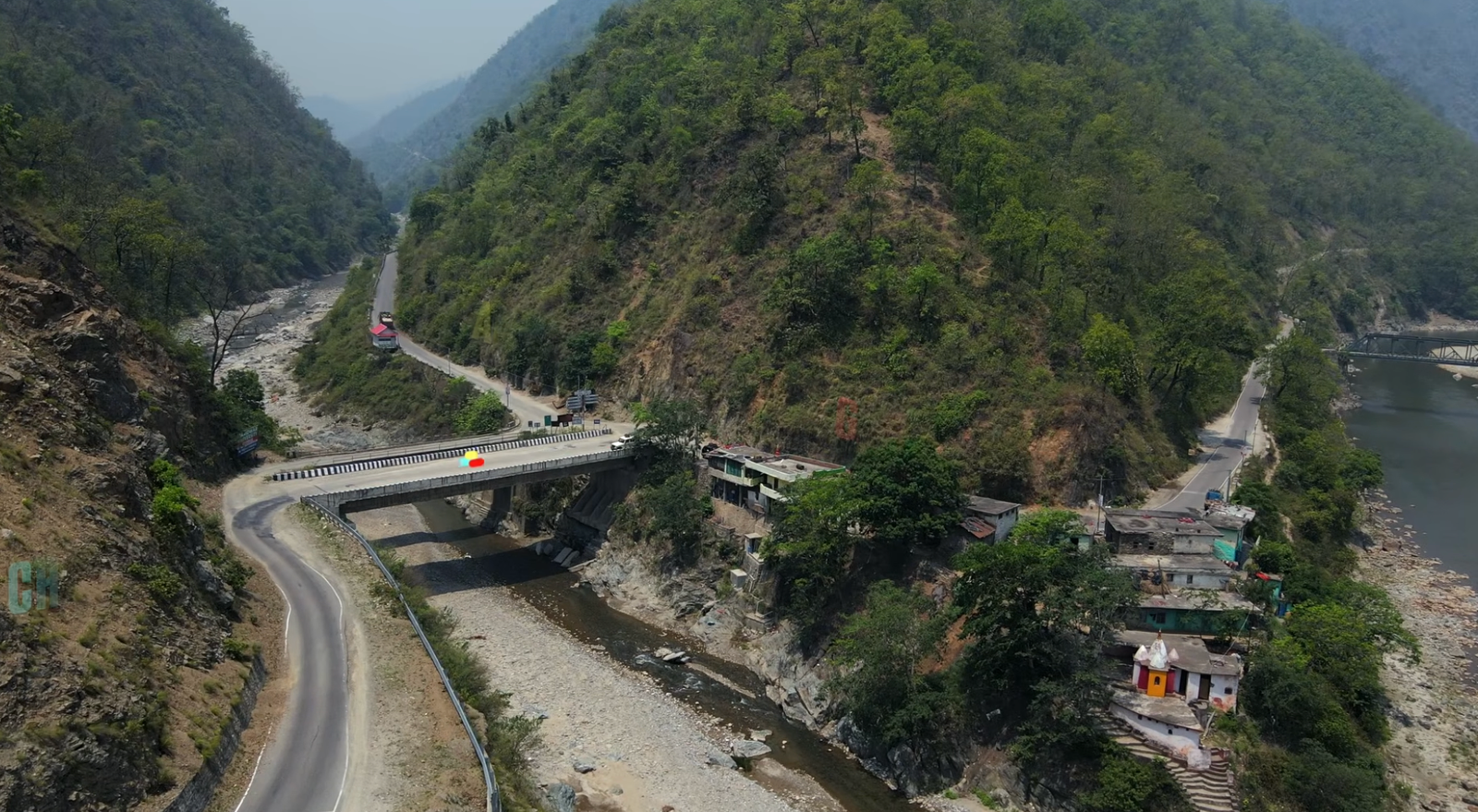
Pithoragarh from above is where this whole Kumaon stretch of the trip started, an aerial view first thing in the morning, Chandak Hill visible in the distance, already marked out as the day’s real destination. This town has a particular character to it too, coaching institutes lining the roads, students here specifically preparing for UPSC, the army, or a banking exam, the whole place quietly oriented around getting young people into government service.
Chandak Hill and a Waterfall Most People Skip
The Pithoragarh market was mostly shut when I got there, Sunday closures, so I settled for Jalebi at an old, well-established shop instead and moved on toward Chandak. Morning tea hadn’t done much for me, so I stopped at Meghna Restaurant on the way up, which turned out to be the right call, two seating sections, and the upper deck genuinely earns its reputation, no trees blocking the valley view the way the lower section has.
The walk up through the pine trees to the viewpoint delivers a proper 180-degree view, Pithoragarh’s houses laid out below, the Naini Saini Airport airstrip visible in the distance, other hill ranges stretching out further still. One honest note here, there’s real plastic litter scattered across the viewpoint, and it stood out to me specifically because I’d just come from Bhutan, immaculately clean by comparison. Worth knowing before you go, since it takes a little shine off an otherwise excellent spot.
Bhurmuni Waterfall is about half an hour further, and the approach itself is worth mentioning, the trail is thick with fallen pine needles, genuinely slippery, the kind of surface that could take a car out on the drive in if you’re not careful. The hike down is about 1km, easy on the way in, considerably more work coming back up. I spent close to half an hour there, floated in the pool for a bit, and honestly, it’s a small waterfall, but the dense jungle setting around it makes it feel like more than it is. If you’re up on Chandak in the evening instead, there’s also a small observatory, ₹100 per person, worth it if the sky’s clear.
London Fort and Getting to Pithoragarh
London Fort has a genuinely interesting backstory, built by the Gorkhas in 1789, originally known as Bowl Ki Garh, and renamed once the Treaty of Sugauli forced the Gorkhas out and handed control to the British instead. The name stuck long after the empire that gave it did.
For getting here in the first place, Tanakpur and Kathgodam are the nearest railheads. If Adi Kailash is on your route afterward, Siltham is the better stop for onward bus and shared-taxi connections than Pithoragarh town itself. Local transport within town runs a bit pricier than you’d expect, taxi or battery rickshaw are your main options, and it’s genuinely worth staying near the bus stand if you’re trying to keep things simple.
A Proper Kumaoni Thali
Lunch at Hilan’s, near the Army Public School, needed a two-hour heads-up to prepare properly, and it was worth the planning. Bhatt Ki Churkani, made from a mountain-grown soyabean variety called Bhatt, roasted extensively in an iron vessel specifically because that’s what actually brings the flavour out, alongside Bhang ki Chutney (mint-forward, made from hemp seed), Saag built from mustard seeds, goosefoot, and Ogal (buckwheat) leaves, Kumaoni Raita with a lighter hand of mustard seed than you’d get on the Nainital side, and Ragi chapati. Jambu herb finishes several of the dishes with its own distinct aroma. Everything here tastes genuinely fresh, like the herbs were picked that same morning, which, this far into the mountains, they very likely were. The whole meal ran ₹250 per person.
The Confluence, Panar Bridge, and Haat Kalika Temple
After offering prayers at Maa Kamakhya Temple that evening, the next morning started at Rameshwar Sangam, where the Eastern Ramganga (which originates in Kumaon, distinct from the Western Ramganga in Garhwal) meets River Saryu. The river carries several names depending on where you are along it, Kali, Mahakali, Karnali, Ghagra, which trips up a lot of people trying to research it. I’d attended the evening Saryu aarti in Ayodhya not long before this trip, so seeing the river at its actual confluence point felt like it closed a loop I hadn’t expected to close.
Panar Bridge, a short drive on, connects three districts at once, Champawat, Almora, and Pithoragarh, and Gangolihat’s market beyond it is genuinely large for a town this size. Haat Kalika Temple, 2km further, sits inside a proper Deodar forest, a real shift after a trip mostly spent among pine trees, and functions as one of Kumaon’s Shakti Peeths. A large bell hangs in the complex, gifted by Kumaon Regiment soldiers in 1918 after their ship survived a storm at sea following prayers to the goddess, and the regiment has contributed to the temple’s upkeep ever since.
90 Feet Underground at Patal Bhubaneshwar
Patal Bhubaneshwar is genuinely unlike any cave I’ve been in, and I’ve seen a fair number of limestone formations on this trip alone. Entry runs a nominal fee, worth confirming current pricing at the counter since it does get revised, plus around ₹150 if you take a guide, which I’d genuinely recommend given how much context they add. It was busy enough on the day I went that the whole visit, queue included, ran close to an hour and a half.
You descend about 90 feet into the cave itself, moderate difficulty, groups of 20 to 25 moving together with a guide, typically 120 to 140 people inside at any given time. The formations are genuinely striking, Adi Ganesh and Brahma Kamal shaped naturally out of the rock, a formation read as Shiva’s long hair, 33 representations of different gods and goddesses through a cave that runs close to 100 metres. No photography or filming is allowed inside, which is exactly why I can’t show you any of it directly, you’ll have to see it yourself.
Timing matters a lot here. As of 2026, the cave closes to visitors from August 11 through October 10 every year, an official monsoon-season measure since oxygen levels genuinely drop and the paths get dangerously slippery during the rains. January through March is the better window if you want to actually take your time inside rather than rush through with a large crowd. Arrive by 8:30 or 9am if you can, the crowd builds hard between noon and 3pm, and thins out again by evening.
The First Real View of Panchachuli, From Chaukori
Staying at KMVN Chaukori put me right in front of a Panchachuli view I’d genuinely wanted to see for a long time, and 5am the next morning delivered it properly, one peak standing taller than the other four. Nanda Devi and Nanda Devi East appear as twin peaks from this Kumaon side, though from Garhwal you’d only see one of them, and a Trishul-shaped peak sits nearby, though it wasn’t visible from where I was standing that particular morning. The property has its own watchtower for an even better angle if the room view isn’t quite enough.
The Goddess of Justice and Birthi Waterfall
On the drive from Chaukori toward Munsiyari, Maa Kokila Temple at Kotgari is worth the stop purely for how it functions locally. It’s known as Nyay Ki Devi, the Goddess of Justice, and people genuinely bring real disputes here instead of, or alongside, the courts, land taken unlawfully, family conflicts, writing the problem on paper and hanging it at the temple, then returning to offer thanks once it’s resolved. It’s a strikingly practical kind of faith, dispute resolution built directly into a place of worship.
The road onward runs along a riverbank for 8 to 10km past Thal, genuinely scenic the whole way, and Birthi Waterfall, about 37km before Munsiyari, is worth the stop even in light rain. It drops over 125 metres, and in August and September the flow is strong enough to drench you just standing near the base, spray carrying all the way down to the bridge below. No swimming here, but the bridge itself doubles as a solid photo spot with the falls behind you. From there, it’s a straight run into Munsiyari for the night.
Practical Info at a Glance
| Patal Bhubaneshwar closure | Closed August 11 – October 10 (2026 dates) for monsoon safety; best visited January–March |
| Cave entry + guide | Nominal entry fee (confirm current rate on-site), ~₹150 for a guide |
| Best arrival time (cave) | 8:30–9am; crowds peak noon–3pm |
| Getting there | Nearest railheads: Tanakpur, Kathgodam; use Siltham as your stop if continuing to Adi Kailash |
Common Questions
When is Patal Bhubaneshwar cave closed?
As of 2026, it’s closed from August 11 through October 10 every year for monsoon-season safety, oxygen levels drop and the paths become dangerously slippery during the rains.
Is Chandak Hill worth visiting?
Yes, for the view and the walk through the pine forest specifically. Go in the evening if you can for the best light, and be aware there’s noticeable plastic litter at the viewpoint.
Where’s the best place to see the Panchachuli range near Pithoragarh?
Chaukori, especially early morning. KMVN’s property there faces the range directly, and the watchtower on-site gives an even wider view.
What should I eat in Pithoragarh?
A proper Kumaoni thali if you can arrange it in advance, Bhatt Ki Churkani especially, roasted in an iron vessel, is worth requesting specifically.
This is the first of four posts covering the same Kumaon trip. From here it continues into Munsiyari (Munsiyari: Handloom Villages, a Missed Glacier, and a Shepherd Who Walks 4 Months Without Home), then Om Parvat and Adi Kailash (Adi Kailash: Snowfall, Gauri Kund, and a Holy Dip Six Years in the Making), and finally Darma Valley (Darma Valley: A 4:30 AM Hike to Panchachuli Base Camp Through Bear Country).
Planning something similar?
Email your route and I’ll reply with honest, first-hand advice, no fluff.
Ask Dhruval →