Asia · Solo Travel
Solo traveller · 15 min read
Region Southeast Asia |
Trip length 1 full day, Merlion Park to Chinatown |
Travel style Solo, with a friend joining in the evening |
Merlion Park, Chinatown, and the Pinnacle@Duxton skybridge together make a genuinely great single day in Singapore, heritage, food, and one of the best budget viewpoints in the city. Chinatown specifically is worth knowing about as a solo, low-budget base, it’s cheaper to stay in than most of the rest of Singapore.
- Merlion Park and the CBD’s reclaimed land
- Kaya toast and the Capita Spring sky garden
- VivoCity, a stranger’s advice, and Singapore’s strict rules
- Chinatown: temples, souvenirs, and a durian first
- Pinnacle@Duxton and how HDB actually works
- Maxwell Food Centre at night
- Practical info at a glance
- Common questions
Merlion Park in the morning is quiet, just a handful of people around, which is exactly the opposite of how it looks from noon onward once the tour groups arrive. I started my day for this one right there, looking at the Merlion with the three-towered luxury hotel behind it and a Durian-shaped performance building nearby that hosts actual theatre and art shows, not just a photo backdrop.
Merlion Park and How Much of This City Is Reclaimed Land
The water body behind the Merlion is Marina Bay reservoir, and the tall buildings ringing it are almost all banks, Singapore genuinely sits among the world’s top four or five financial hubs, with several global banks headquartered right here. You’ll notice small overhead gantries on the roads too, that’s ERP, Singapore’s electronic road toll system, deducting charges automatically to manage traffic in busier areas.
The Fullerton Hotel nearby is a genuine piece of history, a heritage building pushing 100 years old, with a sister property, The Fullerton Bay Hotel, giving a different angle on the same waterfront. This whole stretch also hosts the Singapore Grand Prix track come September and October. A quieter, heavier piece of history sits at Clifford Pier close by, this is where Mahatma Gandhi’s ashes were immersed, back when this entire area was still open ocean rather than the reservoir and reclaimed land you’re standing on now. Singapore has genuinely reshaped its own coastline over the past century, the hotel I mentioned, and Changi Airport itself, both sit partly on land that used to be sea. There’s a real, long thread connecting India and Singapore too, a trade route running back 200 to 500 years, and a major base of the Indian National Army was once here as well.
Kaya Toast and the Capita Spring Sky Garden
Crossing over to One Raffles Place, right by Raffles Place MRT, put me about a fifteen to twenty minute walk from Marina Bay Sands. Right behind it is the Capita Spring building, and its 51st-floor sky garden gives a proper view over the whole financial district, tall buildings stretching out below, an open ground visible from height, and the red People’s Park Complex marking where Chinatown begins.
Breakfast was Kaya Toast at Ya Kun, a chain with branches everywhere but this one specifically at One Raffles Place, jam made from coconut milk and pandan leaf, butter, crispy bread, and a side of egg to dip the toast into, which genuinely lifts the whole thing. I like slotting an old, established eatery into an itinerary when I can, and this one’s been running since 1944. The coffee here uses condensed milk rather than fresh cow or buffalo milk, and it’s a proper pairing with the toast, a completely standard Singaporean breakfast that’s absolutely worth having at least once.
VivoCity, a Stranger’s Advice, and Singapore’s Strict Rules
A change of plan took me to VivoCity before Chinatown, and it’s got a view I hadn’t expected, Sentosa Island laid out right in front of you, hotels and Universal Studios visible across the water, peaceful in a way that feels like standing at the edge of the ocean. Families come here specifically to relax in the evening, and it’s exactly the kind of unglamorous, genuinely useful stop that doesn’t make most Singapore itineraries.
I got chatting with a local there, and he ran through the rules that actually catch tourists out: you can’t carry Durian into a hotel or onto public transport, jaywalking isn’t casual here, cross only at designated spots on a green signal, chewing gum is banned outright, and smoking is restricted to designated areas with a real obligation to dispose of cigarette butts properly. I mentioned paying a $300 fine myself, six or seven years back, for exactly that, dropping a cigarette butt improperly. I don’t carry cigarettes during the day here anymore, which tells you the fine did its job. He was quick to add that there’s real freedom alongside the rules too, drinking in public is fine as long as you’re not disturbing anyone, it’s not as locked-down as the fines list makes it sound.
Back inside, the food court had a stall called Peace Vegetarian, and I tried something called Thunder Tea Rice on a whim, rice at the base, vegetables, peanuts, and radish on top, then tea poured directly into the bowl before eating. Coriander, mint, and basil sit in there too, alongside a tea leaf I couldn’t identify. It worked far better than I expected on the first bite, the peanuts especially giving it a nutty edge I wasn’t anticipating. Worth trying if you see it on a menu here.
Chinatown: Temples, Souvenirs, and a Durian First
Two MRT stops on the purple line got me into Chinatown, and the discipline here is immediately obvious, everyone keeps left on the escalators, leaving the right side clear for anyone in a hurry, a small thing I kept noticing all day. Lim Chee Guan, a famous local eatery known for its pork dishes, sits right outside the station.
The Buddha Tooth Relic Temple was the actual reason I’d come. Genuinely beautiful architecture, four floors, a Maitreya Buddha statue and several smaller ones on the way up, and on the fourth floor, the tooth relic of Gautama Buddha itself, covered in a 320kg gold plate, no photography or filming allowed up there. The temple canteen serves Veg Laksa, but only on Wednesdays and Sundays, worth timing your visit around if you want it, since Veg Laksa is genuinely rare in a city where Laksa usually means the non-veg version. Outside, groups of people play Mahjong near the temple pretty much any time of day.
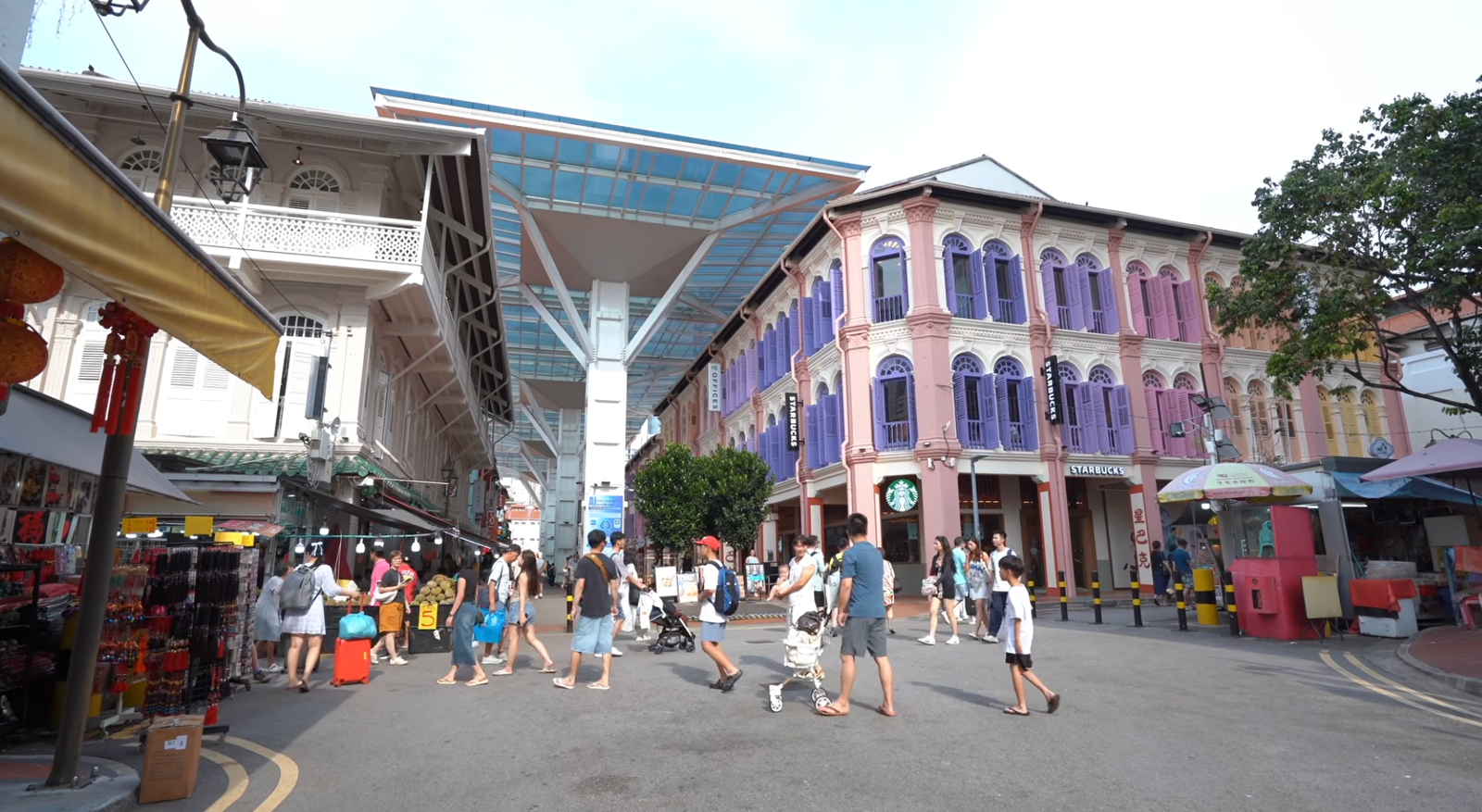
The shophouses through Chinatown share a uniform door design even as their colours vary, genuinely pleasant just to walk past and look at. Souvenir shopping here is cheap and constant, a fridge magnet for $2, tiles around $6 to 8, pot coasters closer to $16.50, and cloth bags at $3 each or 5 for $10. The Chinatown Heritage Centre has a free ground floor if you just want a look, with a $25 guided tour if you want the fuller story, and just like the India connection at Merlion Park, the China-Singapore relationship here runs deep too. Sri Mariamman Temple, the oldest Hindu temple in Singapore, built in 1827, sits on Pagoda Street, and I went in and prayed during an active prayer service, a genuinely calm moment in the middle of a busy day. Chinatown itself is a smart base if you’re travelling solo on a budget, cheaper than most of the city, with Little India also within easy reach if you’d rather stay there instead.
Durian is everywhere here, boxes going for $5 to 8 each depending on variety, sometimes three for $20. I finally tried it, $5 well spent, and it’s exactly as divisive as its reputation suggests, the smell isn’t pleasant, but the taste is genuinely buttery and creamy, close enough to being Singapore’s answer to how India treats the mango. I couldn’t find anywhere to wash my hands afterward, which in hindsight mattered, since the fruit’s smell drew honeybees, and I ended up getting stung while trying to finish it. A small price for a first Durian experience, though I’d recommend having a way to clean up nearby before you commit to eating one on a street corner.
Pinnacle@Duxton and How HDB Actually Works
Pinnacle@Duxton is impossible to miss once you’re in Chinatown, a genuine landmark. My friend Aniruddha, who actually lives in the building, met me on the terrace, and the view from up there is properly impressive, the PSA port on one side, and Guoco Tower, Singapore’s tallest building, standing noticeably taller than everything else around it.
Aniruddha walked me through the basics of HDB versus Condo living here, since it’s a genuinely useful thing to understand about Singapore even as a visitor. HDB, public housing, comes at a subsidised rate, but you need citizenship or a PR visa to buy one. Condos are private, no such restriction, but roughly double the cost, if an HDB unit runs around a million Singapore dollars, the equivalent Condo sits closer to two to two and a half million, and property prices here have generally kept climbing since. What struck me most is how transparent the whole system is, every transaction is genuinely traceable and publicly visible, nothing opaque about historical pricing the way property markets often are elsewhere.
Tourists can absolutely visit the skybridge on the 50th floor, a ticket from the office at the base of Block 1G runs around SGD 6. Go earlier than I did if you can, arriving closer to 5pm would have given me more time up there before it closed.
Aniruddha also mentioned something that reframed how I saw all the food courts I’d been eating at, most Singaporeans cook at home maybe 5 to 10 times a month, roughly 70% of meals happen outside, since eating out is genuinely cheap and convenient, especially at hawker centres. Most HDB blocks have their own food centre on the ground floor for exactly this reason.
Maxwell Food Centre at Night
Maxwell Food Centre was still genuinely crowded at 8:30pm, though a few stalls had already shut, being afternoon-only operations. Tian Tian Hainanese Chicken Rice, probably the most famous stall in the whole centre, was closed, so I took chicken rice from a different stall instead. Aniruddha was fasting that day, so he kept me company without ordering anything himself.
I went with roasted chicken over steamed, served with soup, soy sauce, and a garlic chilli sauce on the side, and it tasted nothing like the chicken rice I’d expected walking in. The rice itself was good, but the sauce is really what set it apart, adding the garlic chilli sauce doubled the flavour and multiplied the spice by roughly five, more chilli in the mix than actual garlic. It works without the sauce too, just far milder and without any real heat. Three distinct flavours in one plate, depending on how you combine the sauces, and the chicken rice itself easily outshone the soup on the side, which I didn’t take to at all.
By 10pm, roughly 80% of the surrounding buildings had already switched their lights off for the night, a handful still lit in a genuinely nice, vibrant colour combination against the dark. The whole area felt noticeably calmer than it had a few hours earlier, a good, quiet way to close out the day.
Practical Info at a Glance
| Getting around | Most tourists can now just tap their own contactless bank card at MRT gates (small foreign-card admin fee applies); a physical EZ-Link card is optional, around SGD 10 total (S$5 non-refundable + S$5 stored value) |
| Pinnacle@Duxton Skybridge | ~SGD 6 per person, 9am–9pm daily, daily visitor quota applies |
| Chinatown Heritage Centre | Free ground floor; ~$25 per person for a guided tour |
| Key rules to know | No durian on public transport/in hotels, no chewing gum, jaywalking and smoking outside designated areas are fined |
Common Questions
Is Pinnacle@Duxton worth visiting?
Yes, genuinely one of the best value viewpoints in Singapore. For around SGD 6 you get a 360-degree view most tourists never see, and it doubles as an honest look at how Singaporean public housing actually works.
What are the strictest rules tourists actually break in Singapore?
Carrying durian into a hotel or onto public transport, chewing gum, jaywalking outside a designated crossing, and smoking outside a marked area all carry real, enforced fines here.
Is Chinatown a good base for solo travellers?
Yes. It’s genuinely cheaper than staying elsewhere in Singapore, strong on food options, and Little India is close enough to reach easily if you want a different base entirely.
Do I need an EZ-Link card in Singapore anymore?
Not necessarily. Most tourists can now tap their own contactless bank card directly at MRT gates. An EZ-Link card still makes sense if you want the Singapore Tourist Pass or prefer keeping transit spending separate from your main card.
This is one of a few Singapore posts from this same trip. If you want the rest of it: Singapore: Katong, Marina Bay Sands, and Little India, A Day in Singapore: Orchard Road to Night Safari, and Sentosa Island and Universal Studios Singapore: An Honest Day-by-Day Guide.
Planning something similar?
Email your route and I’ll reply with honest, first-hand advice, no fluff.
Ask Dhruval →