Asia · Solo Travel
Solo traveller · 18 min read
Region Thimphu, Bhutan |
Trip length 2 days, Episode 1 of 5 |
Travel style Solo, with a guide and driver (mandatory in Bhutan) |
Thimphu genuinely earns two full days: Buddha Dordenma and the Wangditse Lhakhang hike for the views, Simply Bhutan’s Living Museum for real cultural immersion, and food built almost entirely around cheese. Every tourist needs a licensed guide and driver in Bhutan, arranged before you arrive, and Indian nationals pay a Sustainable Development Fee of ₹1,200 per person per night, separate from every other cost.
- The Clock Tower and Thimphu’s traffic-light-free streets
- Cheri, and the legend of a saint who married an angel
- Buddha Dordenma: 54 metres of gold-plated bronze
- A Thimphu lunch built entirely around cheese
- Craft Bazaar and the Centenary Farmer’s Market
- The hike to Wangditse Lhakhang
- Takin, Blue Sheep, and the Royal Takin Reserve
- Simply Bhutan: a genuine living museum
- Practical info at a glance
- Common questions
Thimphu is where this five-part Bhutan trip actually starts, though I’d already entered the country by land through Phuentsholing a few days before. Paro, an hour’s drive away, holds Bhutan’s only international airport, so most visitors see Thimphu either right after or right before flying out. I stopped first to take in the view, houses spread across the hillside, the Wangchu (also called the Thimphu Chhu) running through the valley below, clouds doing something genuinely pretty overhead. March turned out to be a good month for it, light enough for a half-sleeve shirt, with April and May pushing tariffs up as the peak season properly sets in.
The Clock Tower and Thimphu’s Traffic-Light-Free Streets
A guide is mandatory throughout Bhutan, and Dorji bhai, mine for this entire trip, met me right at Clock Tower Square. The tower itself is 45 years old, a gift from the Swiss king to Bhutan’s fourth king, and it doubles as a genuine amphitheatre, hosting performances and public functions. Bhutan’s constitutional democracy only dates to 2008, most executive power resting with the Prime Minister rather than the King, who now reigns as the fifth in the line.
What actually stopped me was the traffic. Thimphu is the only capital in the world without a single traffic light, pedestrian crossings work entirely on cars stopping automatically, and traffic police still direct flow by hand at the busier junctions, a genuinely traditional system that just works. I watched it hold for a solid five minutes before quite believing it. Zombala 2, a short walk on, does a genuinely good crispy non-veg momo and a Veg Bhakthuk, handmade noodles with carrot and spinach, spiced exactly to how much heat you ask for. The “2” in the name just means it’s their second branch, the original sits in the Hong Kong Market and stays closed Sundays.
Cheri, and the Legend of a Saint Who Married an Angel
Cheri Picnic Point, also called Dodina, sits about 40 minutes north, right at the edge of Jigme Dorji National Park, a permit needed if you want to go further in. This is the same Thimphu Chhu I’d seen from above that morning, now close enough to walk a wooden bridge right over it, genuinely one of the calmer, less-visited spots I found in Thimphu. A rock carving nearby depicts Phajo, a saint said to have married an angel and fathered four sons, and who meditated in a temple visible on the mountain above, a four-hour round trip if you want to actually go up. Zhabdrung Ngawang Namgyal, the Tibetan-born figure who unified Bhutan, meditated at that same temple and is said to have brought his father’s relics there from Tibet.
Buddha Dordenma: 54 Metres of Gold-Plated Bronze
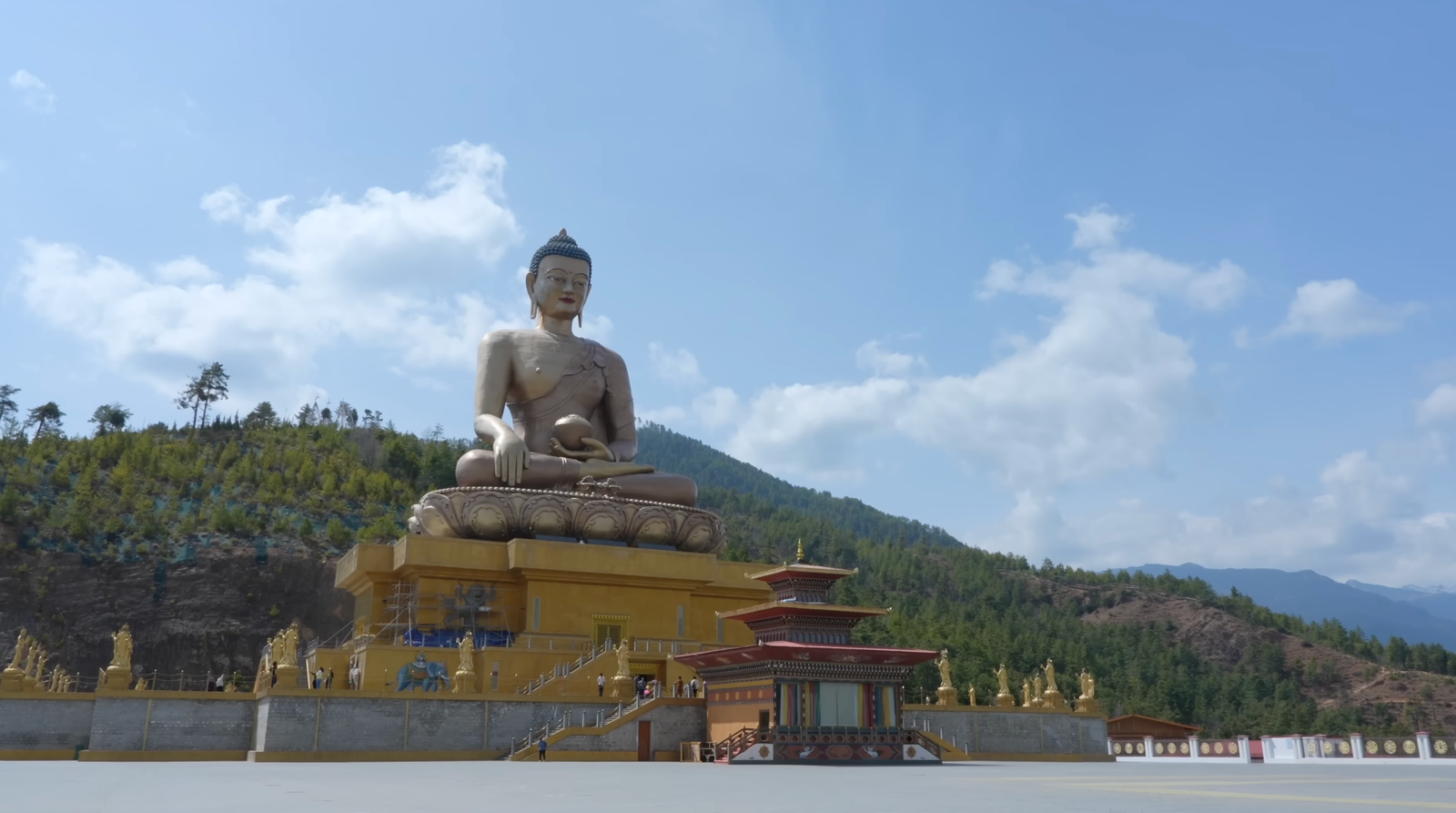
Buddha Dordenma is the one image most people already associate with Thimphu before they arrive, and it’s genuinely bigger in person than photos suggest, 54 metres of brass and copper, gold-plated, completed in 2015, sitting on a mountaintop with a long view over the whole valley. Entry runs ₹500 per person. Inside, alongside the main Vairocana Buddha idol and eight Bodhisattva figures, sit somewhere between 20,000 and 30,000 smaller Buddha idols already in place, part of a long-term plan to eventually house 125,000, 100,000 at 8 inches and 25,000 at 12 inches. Sixty-four Dakini statues, described as angels of offering, stand outside. It’s windy up here by afternoon, so time your visit earlier if you can. A kilometre downhill, Ambe Mata Temple is worth the stop too, photos allowed outside only, and it’s a genuinely easy way to tell government from private buildings across Thimphu afterward, green roofs mean private homes and apartments, red roofs mean government offices.
A Thimphu Lunch Built Entirely Around Cheese
Babesa Heritage Home, back in the city, opened with butter tea while lunch finished cooking, salt, butter, and tea leaves churned together with Mistletoe rather than milk, a version I’d first had in Mana Village, Uttarakhand, and again later in Sikkim. Puffed rice (murmure) stirred straight into the cup rounds it out nicely.
The actual meal was a genuine introduction to Bhutanese cheese culture: Red Rice, Ema Datshi (green chilli cooked in cheese, and I mean this literally, it’s eaten daily here, not weekly, alongside a separate chilli paste with onion and ginger), Fried Cheese, Gondo Datshi (fried cheese with egg folded in, a completely new combination for me), steamed mixed vegetables, rice noodles with Nutrella, a Sichuan-pepper pumpkin soup, and cauliflower cooked simply in cheese with no other spice at all. Ema Datshi doesn’t read as spicy the way you’d expect from the chilli content, the cheese absorbs most of the heat and leaves just the flavour behind.
People here eat Ema Datshi daily, not weekly. By the time I leave Bhutan, I’ll have gone through more cheese varieties than I have in years back home.
Craft Bazaar and the Centenary Farmer’s Market
Dechen Phodrang Monastery, on the way back into town, gives a proper vantage point over Thimphu, the Supreme Court building visible from here and genuinely built to resemble a Buddhist temple rather than a typical courthouse, the Parliament and central Administration buildings sitting close by. Craft Bazaar itself runs about 85 shops, raised above the main road with its own dedicated pedestrian walkway, a sling bag ran ₹550, a yak-wool version closer to ₹1,000, and traditional woolen jackets sit around ₹5,000.
The Centenary Farmer’s Market, open daily despite technically being the weekend market, is worth a proper walk through, ground floor stocked with produce imported from India, the first floor local and organic and roughly double the price. I picked up dried pumpkin, the Sichuan pepper used in that soup earlier, roasted crispy rice (zaw, usually eaten with butter or milk tea), and local jaggery, around ₹100 for a small portion. Worth knowing: Bhutan’s newer currency notes are genuinely tear and water resistant, and change often comes back as a mix of Ngultrum and Indian Rupees, which are treated as interchangeable here. About 80% of the vendors running this market are women.
The Hike to Wangditse Lhakhang
Day two started with a 2.5km hike, about 1.5 hours each way at a normal pace, genuinely low-difficulty and worth every minute for the air alone, Bhutan’s air quality is something else entirely, no litter anywhere along the trail. Wangditse Lhakhang itself dates to the 17th century, renovated on the outside but original inside, a large Buddha idol flanked by eight stupas depicting scenes from his life. Shoes come off before entering, and once they do, no photography is allowed inside, only outside the temple grounds. The temple staff invited me in for black tea and a local snack on the way up, and the viewpoint just before the temple gave the single best 180-degree view of Thimphu I found on this whole trip, better even than the earlier vantage point near Dechen Phodrang.
Takin, Blue Sheep, and the Royal Takin Reserve
The Royal Takin Reserve, 300 Ngultrum entry, both Ngultrum and Indian Rupees accepted, introduced me to Bhutan’s national animal, and I’ll admit I’d never even heard of a Takin before this trip. Goat-shaped skull and tail, cow-sized body, found almost nowhere outside Bhutan, China, Myanmar, and small pockets of Northeast India. Sambar deer, Goral, Himalayan Serow, Blue Sheep (genuinely rare to see this close, even in a reserve setting), Yak, and Himalayan Monal birds share the same grounds. Thirty minutes is enough if you’re tight on time, an hour if you want to properly walk the platform. A small coffee shop near the exit does a solid hazelnut latte, and the Peach Blossom trees around it were in full bloom on my visit.
Simply Bhutan: A Genuine Living Museum
Simply Bhutan, also called the Living Museum, charges ₹1,000 per person (₹200 for Bhutanese nationals, free for guides), and it’s genuinely worth the higher ticket. Geeta, who hosted us, opened with a traditional wine welcome, wine held in the right hand, a finger dipped in and sprinkled three times while saying “Chhu,” an offering to God before the first sip together. The walls carry photos of all five kings, including the current fifth king’s ten-year-old son, the future king, alongside a striking 1958 photo of Pandit Nehru and Indira Gandhi visiting Bhutan.
A genuinely charming detail: the Dapa, a traditional wooden couple’s plate, comes in two sizes, the larger for the wife, smaller for the husband, and tradition holds that couples who eat from this plate stay together for life, not unlike the seven rounds taken around fire in Indian wedding tradition. The traditional kitchen section shows the tools once used to churn butter tea and store it, and outside, red chilli, mushroom, pumpkin, and corn dry in the sun for the winter months ahead. Tshechu masks on display are used in the mask dance performed across Bhutan’s 20 districts on a rotating monthly calendar, similar in spirit to Ladakh’s Cham dance, the largest Tshechu happening every October in Thimphu itself, running three days. I finished with a traditional dance performance, butter tea and roasted rice on the side, and a few rounds of archery, which I did not win, though they performed the celebratory dance for me anyway.
Practical Info at a Glance
| Sustainable Development Fee | ₹1,200 per person, per night for Indian nationals, separate from accommodation, meals, and guide costs |
| Guide and driver | Mandatory throughout Bhutan, arranged before arrival through a licensed operator |
| Buddha Dordenma | ₹500 entry; best visited before afternoon winds pick up |
| Best time to visit | Roughly 6 months of the year are ideal; April–May is peak season with higher tariffs |
Common Questions
How much does the Bhutan Sustainable Development Fee actually cost?
For Indian nationals specifically, ₹1,200 per person per night, separate from your tour package, accommodation, and guide costs. Other nationalities pay considerably more, around USD 100 per night.
Do I really need a guide in Bhutan?
Yes, it’s mandatory for tourists, arranged in advance through a licensed operator. Your guide and driver travel with you for the full trip, not just individual day tours.
Is two days enough for Thimphu?
Yes, comfortably, Buddha Dordenma and the Takin Reserve on one day, the Wangditse hike and Simply Bhutan on the other, with room to spare for shopping and food.
What should I eat in Thimphu?
Ema Datshi is non-negotiable, it’s the national dish for a reason. Gondo Datshi (fried cheese with egg) is worth seeking out specifically if you haven’t had it before.
This is the first of five posts covering the full Bhutan trip. From here, the plan was Tiger’s Nest next, though rain had other ideas: Bhutan: The Snow That Cancelled Haa Valley, followed by Tiger’s Nest: 245 Steps, a Dizzy Spell, and a Festival, Punakha to Trongsa: Two Rivers, One Crane, and Bhutan’s Largest Dzong, and finally Bumthang: A Lake That Burns and Bhutan’s Cultural Heartland.
Planning something similar?
Email your route and I’ll reply with honest, first-hand advice, no fluff.
Ask Dhruval →