Asia · Solo Travel
Solo traveller · 17 min read
Region Paro & Haa Valley, Bhutan |
Trip length 2 days, Episode 2 of 5 |
Travel style Solo, with a guide and driver |
Chele La Pass and Haa Valley are both genuinely worth building a day around, though snow can close the pass with real suddenness even outside peak winter. Haa’s Black and White Temples specifically reward the detour, and Bhutan’s rural homestays here run 400 years deep in the same family. Build a buffer day into your itinerary if you’re visiting anytime weather is remotely unpredictable.
- When rain cancelled Tiger’s Nest
- Snow, Thukpa, and a car that couldn’t go further
- Chuzom Bridge: where two rivers become one
- Haa Valley and a proper bukhari breakfast
- The Black Temple and White Temple of Haa
- A 400-year-old homestay and Haa’s quiet scale
- Finally reaching Chele La Pass
- Practical info at a glance
- Common questions
The plan going into this day was simple: overnight near Paro, an early start for Taktsang Lhakhang parking, Tiger’s Nest at first light. Rain rewrote that plan overnight, and we pivoted to Haa Valley instead, a route that runs straight through Chele La Pass, today’s actual main event, whether I’d planned it that way or not.
When Rain Cancelled Tiger’s Nest
Bhutan’s itineraries genuinely need this kind of built-in flexibility. Mini Tiger’s Nest was visible in the distance from the hilltop where I’d planned to stay, and Paro’s airstrip too, though trees blocked a clean view, a better vantage point saved for the return leg. On the way out of town, a local dart game caught my attention, two teams of nine, alternating turns, singing and dancing whenever someone hit the target, colourful scarves handed out to the most accurate players. I picked up a dart just to feel the weight of it, no real skill involved on my end, but genuinely fun to watch properly played.
Snow, Thukpa, and a Car That Couldn’t Go Further
Fresh snow showed up a full 20km before Chele La Pass, earlier than anyone expected. We stopped to enjoy it properly, Paneer Thukpa by a wood fire, ₹50 a cup, a rice-based version with a Schezwan pepper kick in every sip, genuinely different from the wheat-noodle Thukpa I knew. Cold enough that I bought a woolen cap off a roadside seller for ₹350, and walking the snow-covered road afterward, no traffic beyond a car every five minutes, pulled up a strong memory of Pahalgam for me.
Six kilometres before the pass, the car simply couldn’t go further, tyres skidding on snow more than half a foot deep. The honest options at that point were a long detour via Phuentsholing to still reach Haa Valley, or turning back to Paro entirely. I let that decision sit for a bit and just enjoyed the moment first, snow-covered pine branches, a road that felt like a private snow garden with nobody else around. I considered walking the remaining 5km to the pass, 10km total on foot, but wet shoes and a long day ahead made that too much of a gamble, disappointing as it was to come this close and not reach it that day.
Chuzom Bridge: Where Two Rivers Become One
The alternate route to Haa Valley passed Chuzom Bridge, and this is a genuine must-stop if you’re ever driving between Thimphu and Paro regardless of your final destination. Thimphu Chhu comes in from the right, Paro Chhu from the left, and together they become the Wang Chhu, a clean, visible confluence right beneath the bridge. Phuentsholing sits 121km one way from here, Thimphu 31km the other. It’s a small stop, but a genuinely beautiful one.
Haa Valley and a Proper Bukhari Breakfast
We reached Risum Resort in Haa Valley well after dark, ₹11,000 for two rooms with breakfast and dinner included, four of us splitting the space. Morning revealed snow-capped peaks I hadn’t been able to see arriving in the dark, clouds slowly climbing the mountainsides in a way that was genuinely worth just sitting and watching over breathing exercises before breakfast.
The resort’s Bukhari, a traditional wood-and-stone stove, was worth understanding properly: wood burns below, stones sit above and retain real heat even once the fire’s gone out, some models built specifically to double as a roasting surface. Shomu, the chef, walked me through breakfast: beaten maize eaten with butter tea, Jabba (wheat flour cooked into butter tea), a genuinely spicy onion-chilli-tomato side dish, local cheese, Tengo (roasted buckwheat with butter and honey), and a buckwheat pancake with jam, honey, and butter, the same buckwheat pancake tradition I’d seen before in Uttarakhand, though this was my first time actually trying the combination this way. In Bhutan, your guide and driver stay with you for the whole trip, generally at the same hotels, not a separate day-tour arrangement.
The Black Temple and White Temple of Haa
The Black Temple, a short drive from the hotel, dates to the 7th century, its name owing either to the dark stone it’s built from or, depending who you ask, a black pigeon that’s said to have landed here at the temple’s founding. Inside, 7th-century murals trace the life of Gautama Buddha, and three idols sit together, Buddha himself, Guru Rinpoche, and Zhabdrung Ngawang Namgyal, the same unifying figure whose relics I’d heard about back at Cheri. A 1×1 foot glass-covered opening in the floor looks straight down into the lake this temple is genuinely built on top of, one of 108 temples constructed across the region specifically to suppress demons, according to tradition.
The White Temple, five minutes on, sits on the River Haa Chhu and was originally the same size as the Black Temple before being extended to accommodate festivals. Inside, worship centres on Lord Amitayus, the deity of long life, alongside fresco paintings and young monks reciting hymns, since this doubles as a monastic school, 46 students currently in training, a routine one student described to me as three times harder than an ordinary school, early mornings, early nights, few holidays.
A 400-Year-Old Homestay and Haa’s Quiet Scale
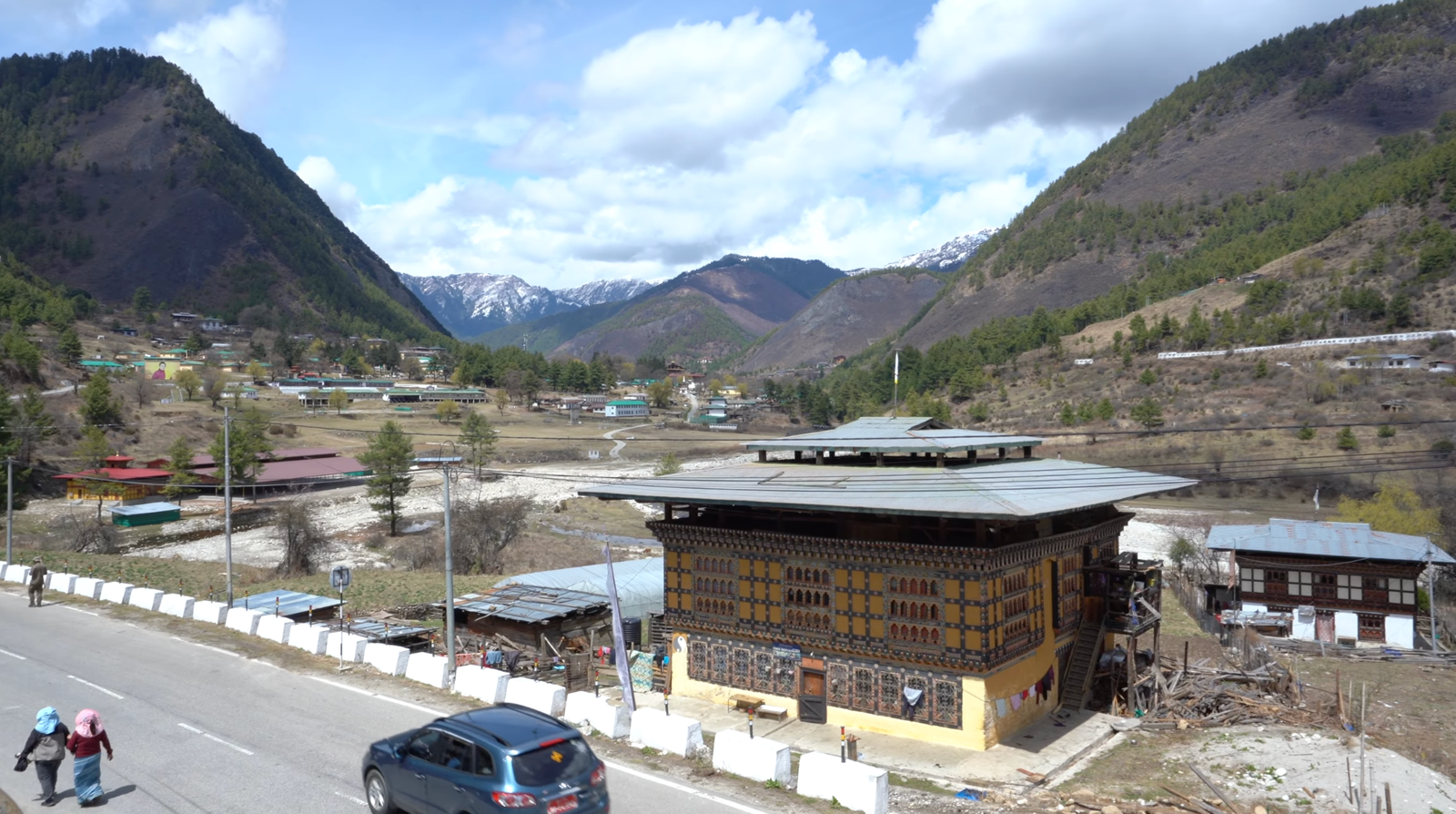
Bhutan’s entire population sits at around 8 lakh, and Haa itself holds just 20,000 to 25,000 people, which explains exactly why the roads here feel so empty. Push further and you’d eventually hit the Tibet-China border, though there’s no direct road route from here, mountains block the way entirely, the same is true toward Sikkim.
Ugyen Homestay, a genuine farm stay, has been in the same family for eight generations, the building itself around 400 years old, stairs narrower than anything I’ve climbed before, barely four to six inches of foot space per step. ₹1,000 per person, ₹500 for an extra bed, shared washroom downstairs. The family’s own artefacts, passed down alongside the house itself, are still on display, polished pine rather than teak, the wood shining from years of care rather than any special treatment.
Lunch back at Risum brought sautéed mini-potatoes, buckwheat momo with cheese and cabbage, Chicken Paa in a thick, minimal gravy, Aloo Dal made from crushed potato rather than lentils, Shamu Datshi (mushroom and cheese), and Lom Kam, dried turnip leaves that hold their flavour surprisingly well for a dried preparation.
Finally Reaching Chele La Pass
On the way back to Paro, the road to Chele La Pass had cleared enough to actually reach it, 3,988 metres, yesterday’s snow still sitting untouched. If it had snowed again that morning instead, we’d have been forced onto the long route regardless. A two-hour round-trip hike from here climbs to a telecom tower for those with clear weather and the time to spare, something I didn’t do this visit, since the weather here genuinely turns by afternoon regardless of how clear the morning looked. Seventy kilometres later, we were back in Paro, Tiger’s Nest now properly next on the list.
Practical Info at a Glance
| Chele La Pass altitude | 3,988 metres; snow can close the road with little warning even in shoulder season |
| Risum Resort, Haa Valley | ~₹11,000 for 2 rooms, breakfast and dinner included |
| Ugyen Homestay | ~₹1,000/person, ₹500 for an extra bed, shared washroom |
| Best hiking window at Chele La | Morning, before afternoon weather typically turns |
Common Questions
Can snow close Chele La Pass unexpectedly?
Yes, even outside peak winter. Build a buffer day into your Bhutan itinerary around this route rather than scheduling it as a single fixed-day plan.
Is Haa Valley worth visiting if you’re pressed for time in Bhutan?
Yes, the Black and White Temples alone justify it, and it’s noticeably less visited than Paro or Thimphu, genuinely peaceful by comparison.
What is a bukhari?
A traditional Bhutanese wood-and-stone stove. The stones retain heat well after the wood burns out, and some designs double as a roasting surface.
Can you get to Sikkim or China directly from Haa Valley?
No, there’s no direct road route in either direction, mountains block the way completely despite the relatively short distance on a map.
This is the second of five posts covering the full Bhutan trip. Start from the beginning in Thimphu: Buddha Dordenma, a Living Museum, and Cheese Every Day, or continue on to Tiger’s Nest: 245 Steps, a Dizzy Spell, and a Festival, Punakha to Trongsa: Two Rivers, One Crane, and Bhutan’s Largest Dzong, and Bumthang: A Lake That Burns and Bhutan’s Cultural Heartland.
Planning something similar?
Email your route and I’ll reply with honest, first-hand advice, no fluff.
Ask Dhruval →
Leave a Reply