Asia · Solo Travel
Solo traveller · 19 min read
Region Paro, Bhutan |
Trip length 2 days, Episode 3 of 5 |
Travel style Solo, with a guide and driver |
Tiger’s Nest genuinely earns its reputation as Bhutan’s must-do trek, easy to moderate difficulty, 5 to 6 hours round trip, and worth every one of the roughly 800 steps from cafe to monastery. Paro itself deserves a full second day too, the market, the airport, the Tshechu festival, and Paro Dzong all sit within easy reach of town.
- Tiger’s Nest: the trek, stair by stair
- Inside Taktsang Monastery
- Paro Market: Thangkas, singing bowls, and Cordyceps
- A hot stone bath, with an honest warning
- Paro Airport: manual landings only
- Mini Tiger’s Nest and the National Museum
- The Paro Tshechu Festival and Paro Dzong
- Practical info at a glance
- Common questions
Tiger’s Nest, properly Taktsang Monastery, finally happened on this leg after rain and then snow had pushed it back twice already. Entry runs ₹1,000, and the full round trip takes 5 to 6 hours, longer than most people expect going in.
Tiger’s Nest: The Trek, Stair by Stair
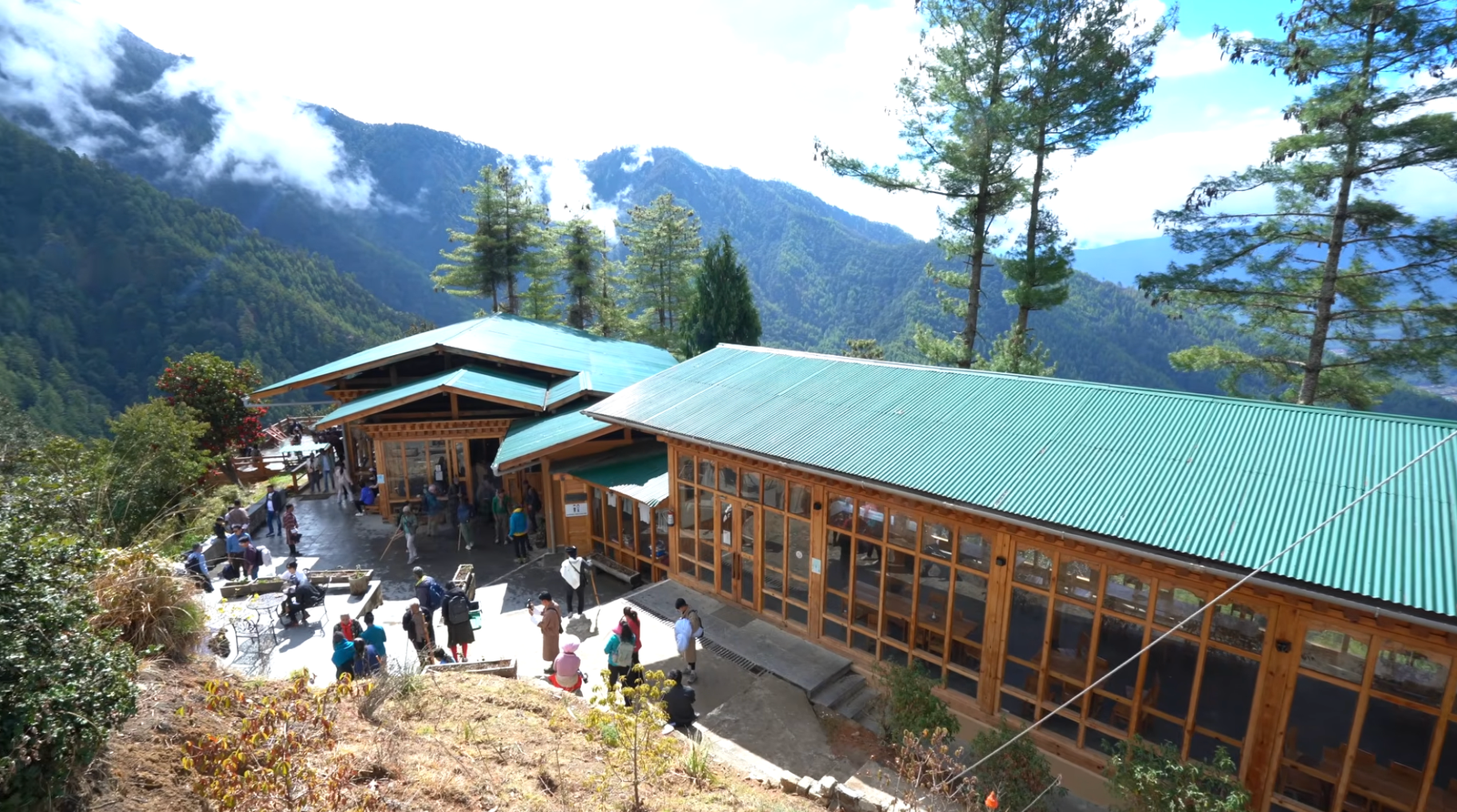
Locals cover the 1.8km to the cafeteria in about 40 minutes, and I ended up counting steps almost the whole way out of curiosity, anything taller than 5 to 6 inches, excluding flat or gently inclined stretches. Cafeteria to viewpoint came to 245 steps, viewpoint to the waterfall brought the running total to 325, and waterfall to the monastery itself added another 232, somewhere around 800 steps total by the time it was all counted. Rhododendron flowers along the way are edible, sour and juicy, and a fungus called Pathar Phool, black stone flower in English, grows here too, used in regional spice blends. If you’d rather skip the walk entirely, helicopter rides run about ₹2 lakh plus GST for an hour, up to five people, tax alone on that is a serious number.
I’d planned this entire Bhutan trip myself, cabs, guide, hotel bookings, all of it, and while I got it done, peak season planning like this is genuinely more effort than it looks from the outside, hotel availability especially. If self-planning isn’t your thing, I’d point you toward a proper travel agency instead, etripto specifically, who I’d worked with before for Darjeeling and Andaman trips and who’ve recently expanded into Bhutan with solid reviews behind them.
A fully bloomed Rhododendron tree near the viewpoint held my attention for a genuine 15 to 20 minutes, and a Yellow-Billed Blue Magpie showed up not long after, a bluish tint on the wing visible if you look closely enough. The waterfall further down freezes over completely once the snow sets in, flowing normally the rest of the year, and the valley view from the bridge crossing it, mountains on either side, is worth the stop on its own before continuing up the final stretch to the monastery.
Inside Taktsang Monastery
Cameras and phones get deposited before entry, no photography inside at all. Nine temples make up the complex, and I made it through six or seven of them, the founding legend centring on Guru Padmasambhava arriving here on the back of a flying tigress in the 8th century to meditate. One idol, depicting the union of wisdom and compassion, genuinely stood apart from everything else I saw inside. An interior viewpoint looks straight out over the Paro valley, worth the ten minutes it takes to just stand there.
Among the four primary joys of life is Nirogi Kaya, a healthy body. I don’t fully have that, sleep apnea and a meniscus tear included, and at 51, I hope I’m still doing hikes like this at 70.
Fried rice at the cafeteria on the way down was a genuine 10 out of 10, and mobile coverage held up across roughly 80% of the trek, a local SIM working far better than international roaming did. The descent took about an hour at an unhurried pace, no rush needed if you’ve got the time.
Paro Market: Thangkas, Singing Bowls, and Cordyceps
Bhutan’s tourism industry actually started in Paro, back in 1984, well before Thimphu developed its own scene, and the market here still carries that first-mover feel, mostly restaurants, handicraft shops, and cafes along a wide road with enough space to move even with cars parked on both sides. Cordyceps shows up in several shops, one variety running $400 for 10 grams, a higher grade closer to $880 for the same weight, alongside Shilajit at similar shops.
Bhutan Craft had genuinely striking Thangka paintings, a Wheel of Life piece at ₹10,800, a considerably more elaborate one, hand-written mantras and a White Tara depiction, at ₹78,800. Singing bowls for meditation ran ₹16,900, and I could feel the vibration off one without even touching it, which says something about the craftsmanship. Brioche Cafe, close by, does a Bumthang Honey Layer cake worth trying before you even get to Bumthang itself, and their homemade ice cream, Salted Caramel and Toasted Hazelnut, is worth ordering both to compare, salt in ice cream is a genuinely strange first experience, though Toasted Hazelnut won out for me by a clear margin.
A Hot Stone Bath, With an Honest Warning
Tshering Homestay runs the Hot Stone Bath experience, sandstone heated to a high temperature and dropped into the water, said to release minerals genuinely good for the body. I sat in a wooden tub with local herbs floating in it, hot but manageable at first, and about twenty minutes in, closing my eyes made my head spin properly. Opening them helped for a bit, but by the time I finished the full 30 minutes, the dizziness came back hard enough that I needed a cold compress and had to lie down in the kitchen before it passed.
Worth passing on directly: drinking water beforehand isn’t enough on its own. Keep something cool on your head the whole time you’re in the tub, that’s the actual fix, not just hydration. Bodies react differently to this, but if you’re planning to try it, that’s the one piece of advice I’d genuinely give first.
Dinner afterward more than made up for it: Turnip Khache (cheese-based, though not technically called Datshi), a pure cow-milk Ema Datshi, rice cake with butter and perilla seed, Mushroom Jaju made with wild Damru leaves, Bean Datshi, and an Asparagus Khache. One mushroom on the table genuinely tasted like meat despite being entirely vegetarian, apparently one that grows specifically along the edges of rice fields. Stay here runs ₹1,500 per room with no meals included, breakfast a separate ₹300, lunch or dinner ₹750 each, shared washroom.
Paro Airport: Manual Landings Only
Paro Airport genuinely deserves its own stop, not just as a transit point. The runway itself runs 2.7km, squeezed between mountains less than 5km apart, and this is one of the few airports in the world where autopilot landing simply isn’t an option, every landing here is fully manual, flown only by specially trained and certified pilots. The terminal building runs entirely on solar power. I caught an actual landing while I was there, a Bhutan Airlines aircraft, part of the Tashi Group, which also runs telecom, mining, and grocery businesses across the country, watching mountains, runway, river, and air traffic all come together in one frame is a genuinely unusual combination you won’t find at most airports.
Mini Tiger’s Nest and the National Museum
Dzongdrakha, known locally as Mini Tiger’s Nest, sees a fraction of the crowd the main site gets, purely because of its outskirts location, and it’s a genuinely easy visit, just 25 to 30 stairs, free entry, no fee at all, unusual compared to most paid attractions on this trip. The monastery here traces back to a 17th-century treasure hunt that uncovered texts and idols of Guru Padmasambhava, the discovery itself is what led to the monastery being built. A Stupa of Relics sits nearby, kept under lock and key specifically to preserve what’s inside.
The National Museum of Bhutan, ₹500 entry, sits above an old watchtower that served that exact function from the 17th century until 1968, now preserved as a heritage building in its own right, with a newer natural history wing built in 2008 alongside it. A full, detailed visit runs about 2.5 hours; I only saw the exterior this time around, priority that day was the festival instead.
The Paro Tshechu Festival and Paro Dzong
Bhutan’s Tshechu festival rotates across all 20 districts on a set monthly calendar, and I got to spend about 1.5 to 2 hours at Paro’s own, dressed in traditional Bhutanese attire for the occasion, which turns out to be required for entering a Dzong, a way of signalling that visitors are, in that moment, ordinary people rather than anything else. The biggest Tshechu of all happens every September in Thimphu, and hotel bookings for it need to go in well ahead of time.
Paro Dzong itself dates to 1645, an entirely wooden structure built through interlocking joinery with no nails at all, functioning today as both an administration block and an active monastery. Inside, a young, Prince-era depiction of Shakyamuni Buddha sits alongside ancient paintings, including one depicting the disciplinary head of the monastic school. Festival performers gather back here each evening once the day’s events wrap up. If you’ve got energy left afterward, bicycle rental in town runs ₹700 an hour, negotiable if you want it for longer.
Practical Info at a Glance
| Tiger’s Nest entry | ₹1,000; budget 5–6 hours round trip |
| Dzong dress code | Traditional Bhutanese attire required to enter any active Dzong during a festival |
| Hot Stone Bath tip | Keep a cool towel on your head throughout, not just water beforehand, to avoid dizziness |
| Mini Tiger’s Nest (Dzongdrakha) | Free entry, far fewer crowds than the main Taktsang trek |
Common Questions
How difficult is the Tiger’s Nest trek?
Easy to moderate. It’s roughly 800 steps in total across the full round trip, manageable at a steady pace with rest stops at the cafeteria and viewpoint.
Should I plan my own Bhutan trip or use an agency?
Self-planning is genuinely possible but takes real effort, especially in peak season when hotel availability tightens. A licensed agency takes that friction away if you’d rather not manage it yourself.
Is Paro Airport worth visiting outside of just flying through it?
Yes, genuinely. Watching a manual landing here, one of very few airports in the world where autopilot isn’t used, is worth setting aside time for on its own.
What’s the difference between Tiger’s Nest and Mini Tiger’s Nest?
Scale and crowd size. Dzongdrakha (Mini Tiger’s Nest) needs only 25 to 30 stairs, is free to enter, and sees far fewer visitors than the main Taktsang trek.
This is the third of five posts covering the full Bhutan trip. Catch up on Thimphu: Buddha Dordenma, a Living Museum, and Cheese Every Day and Bhutan: The Snow That Cancelled Haa Valley, or continue on to Punakha to Trongsa: Two Rivers, One Crane, and Bhutan’s Largest Dzong and Bumthang: A Lake That Burns and Bhutan’s Cultural Heartland.
Planning something similar?
Email your route and I’ll reply with honest, first-hand advice, no fluff.
Ask Dhruval →