Asia · Solo Travel
Solo traveller · 19 min read
Region Bumthang, Central Bhutan |
Trip length 3 days, Episode 5 of 5 (series finale) |
Travel style Solo, with a guide and driver |
Bumthang genuinely earns its reputation as Bhutan’s spiritual and cultural heartland, Kurjey Lhakhang’s three ancient temples, a 300-year-old heritage museum at Ogyen Choling, and Burning Lake’s 1476 legend all sit within easy reach of each other. Spring and autumn are the popular seasons; monsoon, landslide risk aside, is genuinely the choice if you want the valley to yourself.
- Kurjey Lhakhang: three temples, one complex
- A closed cheese factory and a very good shop instead
- Ogyen Choling: a 300-year-old heritage museum
- Bumthang’s cultural heartland, according to someone who’d know
- Burning Lake: a legend from 1476
- A last Bhutanese lunch
- Practical info at a glance
- Common questions
Bumthang closes out this Bhutan trip, and the airport view alone signals a shift, the runway backed by the Chamkhar Chhu, Jakar Dzong’s red roof visible from the same spot, Bumthang Court sitting smaller in the frame beside it. Central Bhutan has a genuinely different character from everything covered so far, and this is where that becomes obvious almost immediately.
Kurjey Lhakhang: Three Temples, One Complex
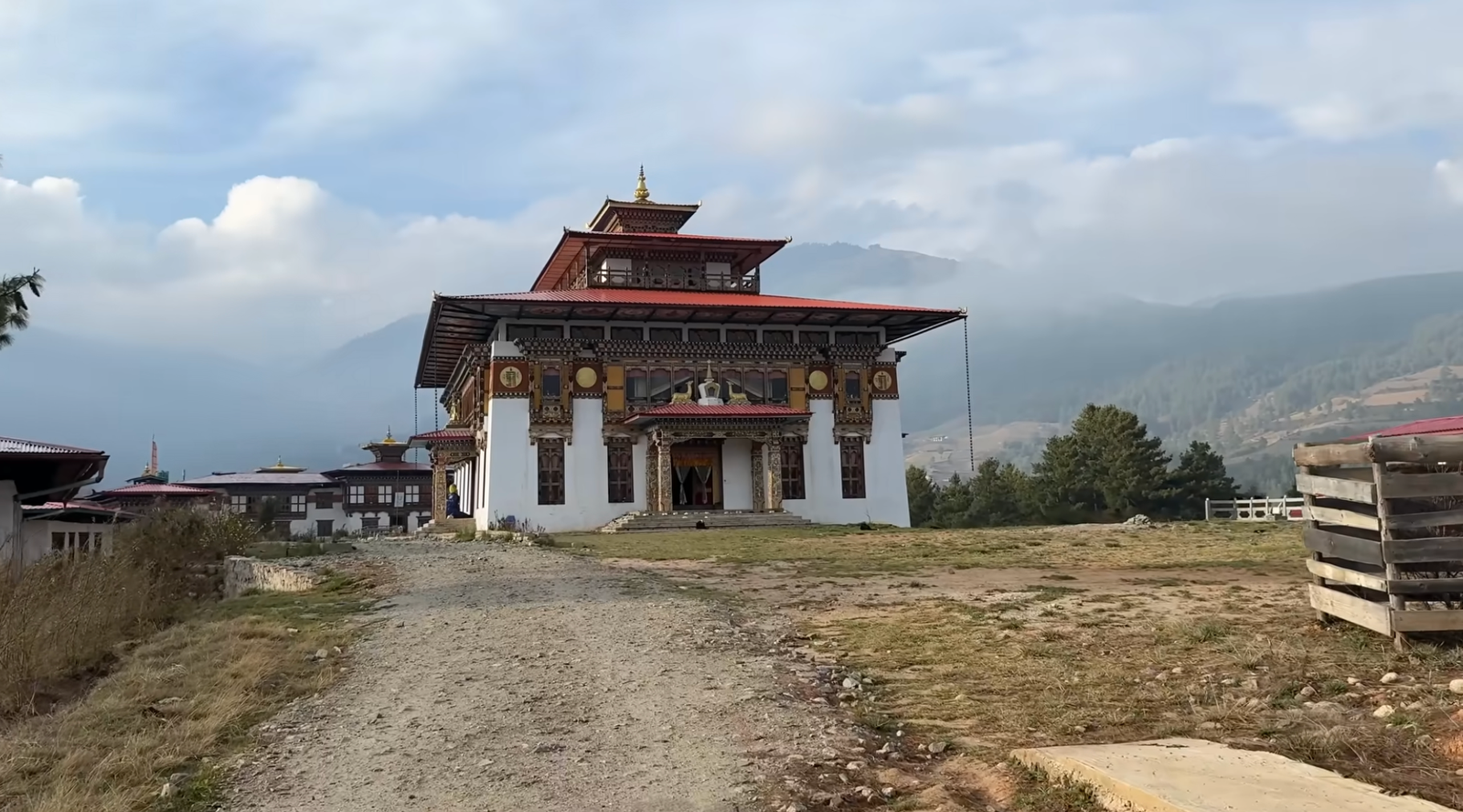
Kurjey Lhakhang, built in the 7th century over what tradition holds was a demon’s left knee, charges ₹500 entry, tourists only, guides and drivers exempt. Three separate temples share the complex: Kalachakra on the right, 15th century, the Buddha temple in the middle, 8th century, and Guru’s temple on the left, 7th century, all genuinely ancient beneath what’s clearly a more recent coat of whitewash, the wooden interlocking roof structure original throughout.
Kalachakra itself is considered a manifestation of Buddha, representing the union of compassion and wisdom, and one detail here is genuinely unlike anything else on this trip: a naked dance ritual, performed after midnight for three consecutive days every mid-November, a tradition unbroken since the 8th century. Devoted attendees come specifically for this, and it happens right where the temples themselves stand.
A Closed Cheese Factory and a Very Good Shop Instead
The Swiss Cheese Factory, one of Bumthang’s better-known stops, was shut the day I visited, but the attached shop more than made up for it. Bumthang’s famous honey ran ₹600 for 500g, buckwheat noodles ₹150, and alongside them, turmeric capsules (a genuinely new format for me), Cordyceps, and a proper spread of teas, mint, black, and rose among them. Blue cheese here is fermented for three to four months, a strong smell that translates into real depth of flavour once it’s actually cooking in a dish.
Ogyen Choling: A 300-Year-Old Heritage Museum
A nunnery on the way to Tang Valley held idols of Guru Rinpoche, Tara Devi, and Dorji Sampa, prayer service genuinely peaceful to sit through, though no videography is allowed inside. Tang Valley itself is where I stayed the night, at Ogyen Choling Heritage Resort, a genuine palace-turned-museum-turned-guesthouse with only 6 to 8 rooms, the stay option itself only introduced about 8 to 9 years ago. The main structure is 250 to 300 years old, partially destroyed in an 1897 earthquake and rebuilt afterward.
The museum tour the next morning covered far more ground than I expected. Three ground-floor galleries: architecture, cloth production, and granary, grain historically stored in cane baskets. Two loom types sit side by side, a backstrap loom, introduced to Bhutan in the 8th century and still common in homes here, and a horizontal frame loom, the kind I’d actually seen before back in India, though never anyone actually working a backstrap loom until now. A set of 120-year-old stairs, genuinely unlike any staircase design I’d encountered before, and a display on Bumthang’s core crops, barley, wheat, and both bitter and sweet buckwheat, two distinct buckwheat varieties I hadn’t known existed until this exact display.
A whole section covers Bhutan’s historical barter economy, Bhutanese rice traded directly for Tibetan salt, using containers built specifically for that exchange, well before Bhutan had any central bank at all. Chinese, Tibetan, and Indian silver coins circulated here until 1968, when the State Bank of India partnered with the newly formed Bank of Bhutan to establish the country’s modern banking system. Brick Tea, tea leaves compressed into a solid block for storage and trade, was a genuinely new concept to me, similar in spirit to a wall-embedded grain storage system I’d once seen and shown from a house in Chhattisgarh, a different solution to the same basic problem of keeping food secure long-term.
The old kitchen’s distillation section had two distinct areas, one for making alcohol, one for storing it, historically kept in the horns of wild buffalo and other animals. A painting nearby depicts a scene from the Bhutan-Tibet war, arrows made from bamboo stalks, tipped with poison carried in a small container built for exactly that purpose. Upstairs, a former VIP guest bedroom later became a family monk’s room, complete with an attached long-drop toilet running straight down to the ground below, and an 1800s-era governor’s office, where the head of the family effectively functioned as judge, drafting land and tax documents at a time when Bhutan had no formal judiciary at all.
Bumthang’s Cultural Heartland, According to Someone Who’d Know
The homestay owner, closing out my visit, put it plainly when I asked what made Bumthang special: a still-preserved landscape with fewer industries than elsewhere, Tang Valley remaining genuinely agricultural, and a spiritual weight to the place that goes back to the 7th century, when the first temple here was built. Every valley in Bumthang, by her account, carries its own layer of temples and history, and calling it Bhutan’s cultural heartland isn’t an exaggeration.
Cottage cheese was our main protein source, since we never relied heavily on lentils the way India does. That’s genuinely why cheese ended up in nearly everything.
Meat, historically occasional here rather than a daily habit, has become more common as availability has widened, though the traditional diet leaned vegetarian by necessity rather than doctrine. On timing: spring, March through May, draws the biggest crowds, autumn brings the festival season, and monsoon, landslide risk aside, is genuinely the season for anyone who wants the valley to themselves. She sent me off with a small memento, a book about the museum and her own family’s history, worth reading properly once I was actually back home rather than mid-trip.
Burning Lake: A Legend From 1476
Rain scrapped the original plan for a three-direction, 40-minute hike out of Tang Valley, and Burning Lake (Membartsho) became the pivot instead, 30 minutes away. I couldn’t resist a short walk along the way despite the drizzle, wheat fields spread out beside the Tang Chhu, water clear enough to see stones sitting a good three feet below the surface. Burning Lake itself isn’t really a lake at all, it’s a section of the river given that name specifically, tied to a story from 1476: Guru Pema Lingpa is said to have jumped into the Tang Chhu holding a lit butter lamp, and emerged still holding it, still burning, along with scrolls of recovered Buddhist texts. Whatever you make of the supernatural framing, it’s a genuinely significant pilgrimage site, and worth the detour on its own merits even setting the legend aside.
A Last Bhutanese Lunch
Dorjibee Village hosted the last real meal of this trip, arranged with just three hours’ notice: radish curry, Ema Datshi, fried potato, Masoor Dal, both buckwheat and wheat noodles, a buckwheat pancake, red rice, mixed vegetables, Saag, and Ezay, a red chilli dip that genuinely earned the title of hero of the meal, cutting through everything else on the table. Roughly half of Bhutan’s population is vegetarian, including a meaningful share who still eat eggs, and schools here actively teach the nutritional case for including eggs even within a vegetarian framework.
Weekend closures meant skipping both the textile weaving centre and the honey bee cooperative I’d hoped to see, a reminder to check opening days ahead of time in smaller towns like this. Chamkhar’s market area closed out the trip, a mix of general store, ATM, and handicraft shop, genuinely quiet compared to everywhere else on this journey. This is where the Bhutan series ends, Dorji bhai stayed on for two more days purely to fulfil the government requirement that guides escort visitors all the way to the border or airport, a formal part of how tourism here is structured, even once the filming itself was done.
Practical Info at a Glance
| Kurjey Lhakhang entry | ₹500, tourists only; guides and drivers exempt |
| Ogyen Choling stay | Only 6–8 rooms; book ahead given the small capacity |
| Best time to visit Bumthang | Spring (Mar–May, crowded) or autumn (festivals); monsoon for solitude, with landslide risk |
| Small-town closures | Check opening days ahead, several attractions here close on weekends |
Common Questions
What is Burning Lake, and is it actually a lake?
Not technically, it’s a section of the Tang Chhu river, named for an 1476 legend involving Guru Pema Lingpa emerging from the water still holding a burning butter lamp and recovered Buddhist texts.
Why is cheese such a big part of Bhutanese food?
Cottage cheese historically served as the main protein source, since lentils were never a dietary staple the way they are in India, a practical solution more than a purely culinary choice.
Is Ogyen Choling worth the stay, or just a museum visit?
Worth the actual stay if you can get a room, only 6 to 8 available. Sleeping inside a 300-year-old heritage building adds something a day visit alone can’t.
When did Bhutan get its first central bank?
1968, when the State Bank of India partnered with the newly formed Bank of Bhutan. Before that, trade ran on barter and Chinese, Tibetan, and Indian silver coins.
This closes out the five-part Bhutan series. If you’re starting fresh or want the full journey in order: Thimphu: Buddha Dordenma, a Living Museum, and Cheese Every Day, Bhutan: The Snow That Cancelled Haa Valley, Tiger’s Nest: 245 Steps, a Dizzy Spell, and a Festival, and Punakha to Trongsa: Two Rivers, One Crane, and Bhutan’s Largest Dzong.
Planning something similar?
Email your route and I’ll reply with honest, first-hand advice, no fluff.
Ask Dhruval →