Asia · Solo Travel
Solo traveller · 20 min read
Region Firozpur, Punjab |
Trip length 2 days, Episode 4 of 4 (series finale) |
Travel style Solo, with a returning guide |
Firozpur genuinely deserves more attention than it gets, the Hussainiwala Beating Retreat ceremony, Bhagat Singh’s actual confiscated pistol in the adjoining museum, and the real, sobering story of why the martyrs’ memorial sits here rather than at the Lahore jail where they were actually executed. Combine it with Amritsar, just 105km away, and give this at least two full days.
- The Hussainiwala retreat ceremony and Bhagat Singh’s pistol
- Saragarhi and Barki: two memorials, two wars
- Why the martyrs’ memorial is here, not at the jail
- Bhagat Singh: four photographs and a reading habit
- Batukeshwar Dutt and a video call to Pune
- How Hussainiwala became Indian territory
- The 1965 and 1971 wars, written on these walls
- Practical info at a glance
- Common questions
Firozpur closes out this Punjab series, and Mr. Pradeep Deswal, who’d joined me before for a Cellular Jail video, was back with me for this one too, starting right at Hussainiwala Border.
The Hussainiwala Retreat Ceremony and Bhagat Singh’s Pistol
The Beating Retreat ceremony here has genuinely changed since I last saw it seven years ago. Back then, the central barricade would open and soldiers from both sides would cross the line to lower their flags together; that no longer happens, each side now lowers its own flag entirely from its own territory. What hasn’t changed is the atmosphere itself, and the genuine opportunity afterward to get one-on-one photos with BSF soldiers, something Wagah’s crowds make far harder to manage.
The museum in the same complex holds something genuinely striking: the actual pistol confiscated from Bhagat Singh after the Central Assembly bombing on 8 April 1929, pistol number 168896, alongside a similar model recovered from Chandrasekhar Azad at the time of his death on 27 February 1931. LMG and INSAS rifles, a rocket launcher, a grenade launcher, and other pistols sit alongside detailed descriptions. Museum hours run 4:30 to 6pm only, closed entirely during the retreat ceremony itself and inaccessible in the morning, worth planning around carefully. A 15-minute documentary on the 1965 and 1971 wars runs in the same complex. A light and sound show used to run here too, destroyed in the 2023 floods and not yet restored. Tourist numbers have grown enormously since my last visit, from roughly 30 to 40 people back then to a genuinely large crowd this time, awareness of this ceremony has clearly spread.
Saragarhi and Barki: Two Memorials, Two Wars
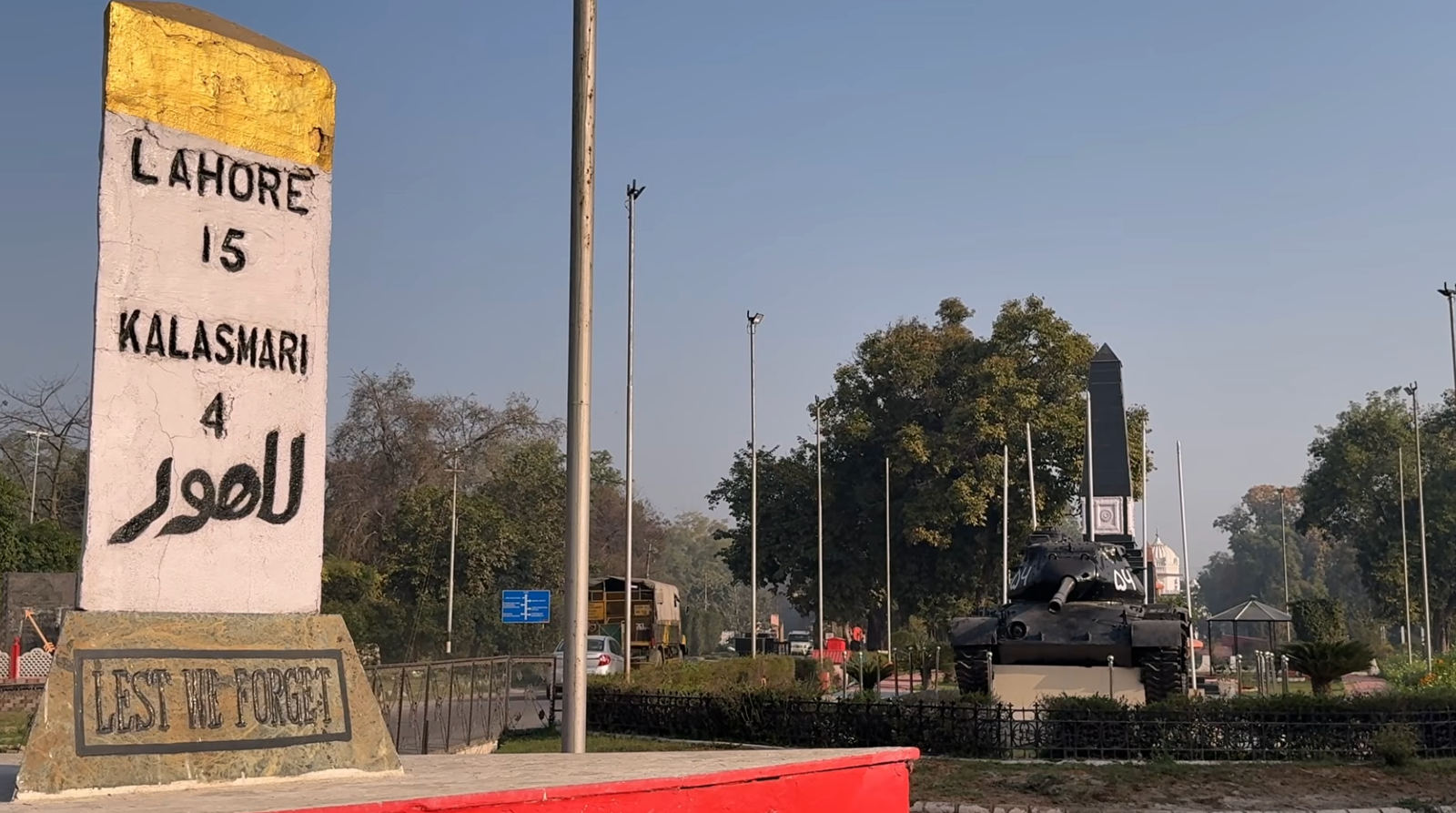
A morning walk through the Cantt area, half an hour in a small garden along the way, led to the Martyrdom Memorials, and specifically Saragarhi Memorial, honouring the 1897 battle where 21 soldiers of the 36th Sikh Regiment held their position against an Afghan force of roughly 10,000. Most of that regiment came from Firozpur specifically, which is exactly why the memorial sits here rather than at Saragarhi Fort itself, which now lies in Pakistan. The 2019 film Kesari, with Akshay Kumar playing Havildar Ishar Singh, is based directly on this battle. Barki Memorial, right beside it, marks how far the Indian Army advanced during the 1965 war, close enough to Lahore that a milestone and a tank recovered from Barki still sit here in Firozpur today.
Breakfast at Ramu Halwai, Puri with a potato-and-chickpea curry, curd, and a proper sweet Lassi, was a genuinely satisfying start before the heavier history of the day ahead.
Why the Martyrs’ Memorial Is Here, Not at the Jail
Shaheed Smarak, 11km from Cantt, is the memorial for Rajguru, Sukhdev, and Bhagat Singh, and it’s a fair question, one Pradeep ji told me comes up often: why is this memorial in Firozpur, 60 to 65km from Lahore Central Jail, where the three were actually executed?
The answer is a genuinely sobering piece of history. They were hanged at 7pm on 23 March 1931, a day earlier than the date publicly believed at the time, and against standard prison manual protocol, which permitted executions only in the morning. The British moved their bodies out secretly via truck rather than releasing them to their families, and brought in a Granthi and a Hindu priest to perform a hurried cremation according to Sikh and Hindu custom, kerosene used specifically to speed the process along, all of it done quietly to avoid public knowledge. The secret leaked anyway, and as people began gathering, the half-burnt remains were thrown into the river rather than allowed to be recovered publicly. What remained was later retrieved and given a proper cremation on the banks of the River Ravi in Lahore.
The British cremated them secretly to avoid public knowledge. When the news leaked anyway, their half-burnt bodies were thrown into the river rather than handed back.
Bhagat Singh: Four Photographs and a Reading Habit
Only four original photographs of Bhagat Singh exist. The earliest, a studio portrait from age 10 to 12, shows him in a turban. The second, a group photo from his time in the National College Dramatic Society, where he acted in plays like Chandragupta and Maharana Pratap, also shows him turbaned. The third, from 1927, taken secretly by police for identification purposes while he was held in a railway lock-up, shows him in chains. The fourth, the famous hat photograph, was deliberately taken before the Assembly bombing specifically so newspapers could identify him once he was arrested, exactly as planned.
He was reading avidly from early childhood, working through books belonging to his uncle, Sardar Ajit Singh, and family friend Sufi Amba Prasad, and had already read some 50 books by his primary school years. On his personal life, he never married; the woman he’d been engaged to, per the norms of the time, later married someone else and had a son, a detail confirmed directly by his mother Maa Vidyavati’s own recorded testimony rather than the more romanticised version some films portray.
A few family details worth knowing: Sukhdev was born in Ludhiana, Punjab; Rajguru in Khed, Maharashtra; Bhagat Singh himself in Banga, in the Lyallpur district of what’s now Pakistan, with Khatkar Kalan serving as the family’s ancestral home rather than his actual birthplace.
Batukeshwar Dutt and a Video Call to Pune
Batukeshwar Dutt, whose Cellular Jail years I’d covered separately before, spent 4 to 5 years imprisoned there, leading a hunger strike during which his companion Mahavir Singh died. Born in Bengal, raised in Kanpur, he spent over 15 years across various jails before settling in Patna after independence. He died on 20 July 1965 at AIIMS Delhi, Maa Vidyavati staying by his side through his hospitalisation, and the Punjab Chief Minister personally offered support during his treatment. His final wish, granted, was to be cremated in Punjab alongside the others.
A genuinely moving moment here: a live video call with Bharti Dutt, Batukeshwar Dutt’s daughter, now based in Pune, right after we’d offered flowers at her father’s memorial. She’d never met Pradeep ji in person despite him living close by on past visits, a small, warm coincidence in the middle of an otherwise heavy day.
Maa Vidyavati’s own memorial sits nearby. She died on 1 June 1975 at Ram Manohar Lohia Hospital, her explicit last wish to be cremated where her sons, Bhagat Singh, Rajguru, Sukhdev, and Batukeshwar Dutt, had died or were memorialised. Thousands joined her funeral procession, which stopped overnight in Chandigarh before reaching Firozpur via Khatkar Kalan for her cremation on 3 June 1975. The Punjab government honoured her with the title Punjab Mata, and her memorial lists all nine of her children in three languages, including Jagat Singh, who died at age 12, and her three daughters, Amar Kaur, Sumitra, and Shakuntala.
How Hussainiwala Became Indian Territory
Before 1962, Hussainiwala sat on the Pakistani side of the border, and the story of how that changed is genuinely worth knowing, as Pradeep ji explained it. Partition drew the Line of Control along the Sutlej River, with the Hussainiwala Headworks on the Indian side but operationally tied to a barrage further along near Fazilka, on Pakistan’s side, a genuinely unworkable arrangement that led to a real skirmish in 1956, Indian Army soldiers killed in the fighting. The 1960 Indus Water Treaty eventually resolved the underlying dispute, and as part of the broader settlement, India exchanged 12 villages for this one, specifically to secure clean control over the Sutlej and its Headworks. On paper, that trade looks lopsided; in practice, this single village happened to be where Bhagat Singh, Rajguru, and Sukhdev were cremated, land whose significance simply couldn’t be measured the same way as the twelve given up in return.
The 1965 and 1971 Wars, Written on These Walls
A surviving section of the 1879 Kesar-E-Hind bridge over the Sutlej once carried both trains and road traffic, and this was genuinely the route the Bombay-to-Peshawar Punjab Mail once ran, via Delhi and Firozpur, connecting cities that today sit across a closed border. Netaji Subhas Chandra Bose is said to have used this exact line during his famous 1941 escape, travelling this route on his way to Peshawar. A “virtual train journey” exhibit here recreates that whole route and the cities along it, genuinely well done.
Cannon and shell-impact marks from the 1971 war are still visible on the walls near the bridge, three sides of attack clearly traceable, the Sutlej at the defenders’ back the entire time. NK Surjit Singh of the 15 Punjab Regiment held this exact position with a machine gun during that assault. The 1965 Battle of Asal Uttar, fought nearby, is considered Asia’s largest tank battle since the Second World War: Pakistan’s 10th Brigade ultimately retreated, leaving 97 tanks behind, 32 of them abandoned with engines still running, after heavily outnumbered Indian troops improvised with jeep-mounted guns and ambush positions hidden in sugarcane fields. Havildar Abdul Hamid, awarded the Param Vir Chakra for destroying seven Patton tanks in that same battle, is a name that deserves to be far better known than it is.
A souvenir shop on site sells Bhagat Singh’s Jail Diary, ₹195, his own handwritten notes and reading observations from prison, genuinely striking for how sharp his economic and political thinking was at such a young age.
Hussainiwala Railway Station itself has no proper platform, and the local train from Firozpur runs here just twice a year, 23 March and 13 April, no ticket needed either day, running 8 to 10 round trips with a large fair on 23 March specifically. Amritsar sits just 105km away, and Fazilka 90km, both easy enough to combine into one longer Punjab route. October through March is genuinely the best window to visit this whole region. This closes out the Punjab series, and I’m already planning a return in 6 to 8 months specifically to visit Bhagat Singh’s ancestral home.
Practical Info at a Glance
| Museum hours | 4:30–6pm only; closed during the retreat ceremony and in the morning |
| Hussainiwala Railway Station | Trains run only 23 March and 13 April; no ticket needed those days |
| Distance to Amritsar | 105km; easily combined into one longer route |
| Best time to visit | October through March |
Common Questions
Why is the martyrs’ memorial in Firozpur instead of Lahore?
Bhagat Singh, Rajguru, and Sukhdev were secretly, hastily cremated near here after their execution, their remains later recovered and properly cremated in Lahore. The Firozpur site marks where that first, secret cremation actually happened.
When can I ride the train to Hussainiwala Railway Station?
Only twice a year, 23 March and 13 April, running from Firozpur with no ticket required either day. A large fair happens on 23 March specifically.
Is Firozpur worth combining with an Amritsar trip?
Yes, genuinely. Amritsar sits just 105km away, making it easy to combine into one longer Punjab itinerary rather than a separate trip.
How many photographs of Bhagat Singh actually exist?
Just four originals: a childhood studio portrait, a college dramatic society group photo, a secretly taken police identification photo in chains, and the famous hat photograph taken deliberately before the Assembly bombing.
This closes out the four-part Punjab series. If you’re starting fresh or want the full journey in order: Patiala: A Dying Art, 22 Pleats, and a City’s 261st Birthday, Jalandhar & Kapurthala: Sports Balls, a Shakti Peeth, and a Moorish Mosque, and Bathinda to Fazilka: A 2,000-Year-Old Fort and the Border at Sunset.
Planning something similar?
Email your route and I’ll reply with honest, first-hand advice, no fluff.
Ask Dhruval →