Asia · Solo Travel
Solo traveller · 18 min read
Region Hai Van Pass & Hue, Central Vietnam |
Trip length 1 day, Episode 7 of 10 |
Travel style Solo, with a driver-guide |
Take Hai Van Pass by road rather than flying between Da Nang and Hue, the coastal views alone justify the extra time. Hue’s Imperial Citadel, entry 200,000 VND, is genuinely worth several hours, a walled city within a city that still carries visible scars from one of the Vietnam War’s bloodiest battles alongside its restored imperial halls.
Da Nang to Hue by road means Hai Van Pass, and I’d genuinely recommend it over flying if you have the time, Trang, who I ended up calling Dimo through the rest of the day, drove and guided through this whole stretch. It’s a short pass on paper, just 21 kilometres, but almost nothing about it feels short once you’re actually on it.
Hai Van Pass: The Ocean Cloud Road
Hai Van translates to “Ocean Cloud,” and the pass earns that name honestly, climbing to 496 metres along a spur of the Truong Son mountain range, mountains dropping almost straight into the sea with genuinely dramatic coastal views the whole way up. This exact stretch of road has been a boundary for a genuinely long time, marking the historical dividing line between the Champa and Dai Viet kingdoms as far back as the 1300s, long before France, Japan, or America ever had a presence here. Jeremy Clarkson, filming Top Gear’s Vietnam special in 2008, called it “a deserted ribbon of perfection,” and that one episode alone is responsible for a huge share of the road’s fame today, The Guardian later naming it one of the world’s great coastal drives in its own right.
At the summit, an old French colonial-era bunker and watchtower still stand in ruins, a physical reminder of just how many different powers have held strategic ground through this exact stretch of coast over the centuries, the French themselves eventually building a railway line to run the pass’s full length rather than trust the narrow, animal- and bandit-prone road alone. Standing at that same summit today, you get Da Nang’s coastline on one side and Lang Co Bay on the other, a genuinely rare vantage point where you can see both stretch out at once. Lang Co Beach itself, all white sand and turquoise water, comes into view properly on the way down, and the drive itself, more than any single stop along it, is genuinely the point, hairpin turns, shifting light, and a kind of quiet that’s hard to find on a more direct route.
Hue’s Imperial Citadel: A City Inside a City
Hue served as Vietnam’s imperial capital under the Nguyen Dynasty from 1802 to 1945, the country’s last ruling dynasty, and the Perfume River runs right through the middle of the city today. The Imperial Citadel, entry 200,000 VND, spans roughly 500 hectares, genuinely massive, walled and moated, conceptually similar to Beijing’s Forbidden City, built to house both the imperial administration and the royal family’s residence within the same fortified grounds, the innermost residential core known as the Purple Forbidden City specifically. UNESCO recognised the whole complex as a World Heritage Site in 1993.
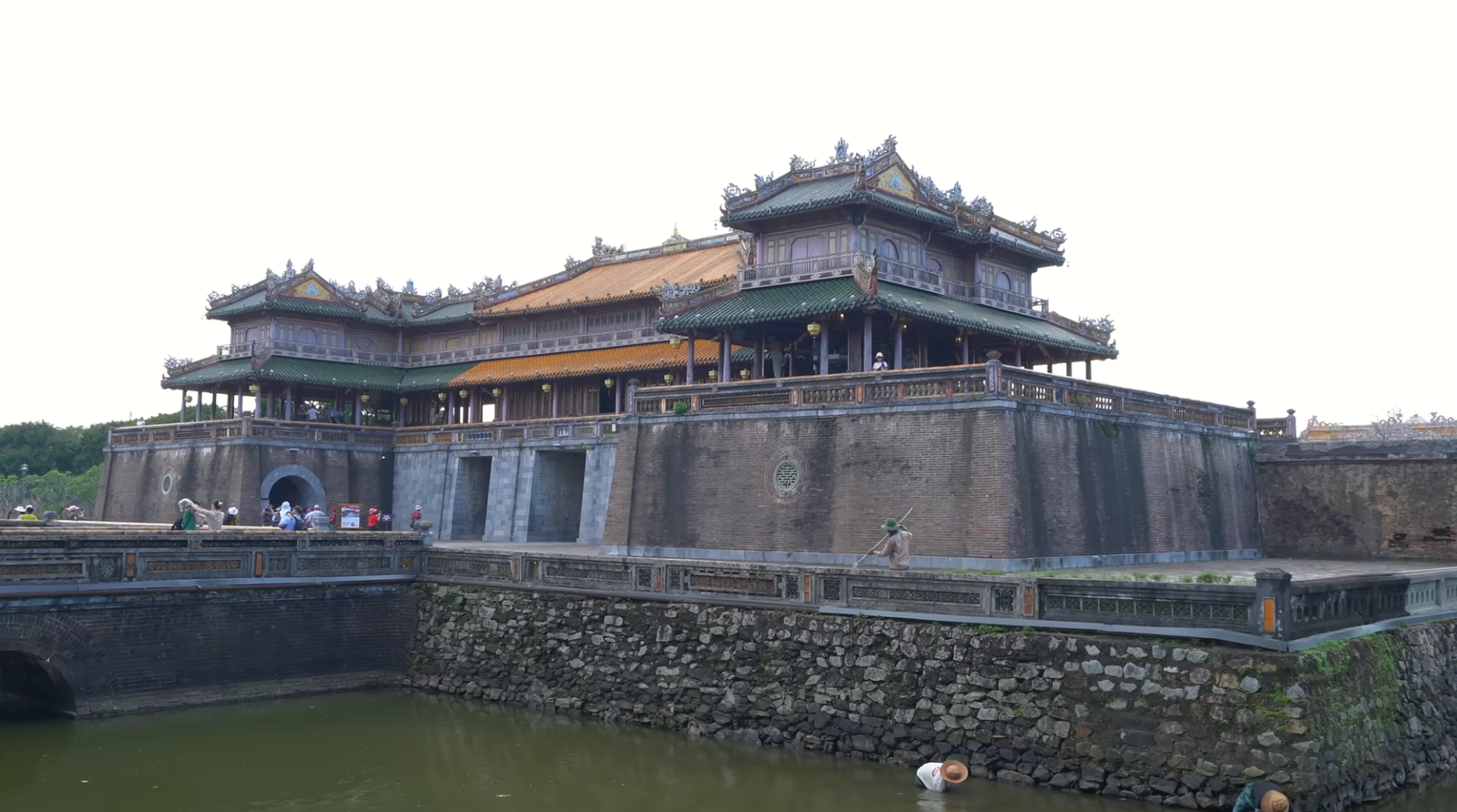
One ticket genuinely covers a lot of ground: Ngo Mon Gate, the main southern entrance and the most photographed single structure in the complex, the Nine Holy Cannons flanking the approach, the Nine Nguyen Dynasty Urns, each cast for a different emperor, and the Nguyen Royal Family Temple, called The To Mieu, where those emperors are formally honoured. Thai Hoa Palace, the former throne room, carries dragon and phoenix imagery throughout, the traditional symbols of royal authority here, and the same ticket gets you into the Truong Sanh and Dien Tho residences, the Thieu Phuong Royal Park, and the Duyet Thi Duong Royal Theatre, once used for court performances and now occasionally still hosting traditional music for visitors.
Worth knowing before you go: not everything inside has been restored, and not everything is covered by the base ticket either. The Citadel suffered genuinely heavy damage during the 1968 Tet Offensive, one of the Vietnam War’s bloodiest battles, fought largely street by street and structure by structure within these exact walls. Some sections stand fully rebuilt today, others remain visibly in ruins or mid-restoration, and walking between the two is a genuinely sobering contrast, gold leaf and dragon carvings in one courtyard, bare foundations in the next. The royal tombs sit outside the Citadel itself as separate paid stops, the tombs of Tu Duc, Minh Mang, and Khai Dinh at 150,000 VND each, Gia Long’s tomb also 150,000 VND, Dong Khanh’s a more modest 100,000 VND, with combo tickets available if you want to cover several tombs alongside the Citadel itself in one trip. The complex overall is large enough that most visitors only see a fraction of it in a single visit, budget real time, several hours at minimum, if you want to properly cover even just the main halls, temples, and gardens rather than rushing the highlights.
A Taste of Hue’s Royal Cuisine
Dinner in Hue carries the same imperial thread as the Citadel itself. The city’s food culture is genuinely built around a refined, royal-court tradition, several small, carefully composed dishes rather than one large plate, a legacy of cooking that once had to please an emperor’s table and, by some accounts, meant a different dish for every single day of the year. I had a vegetarian version of Hue’s well-known spicy noodle soup, and the level of care in the seasoning was obvious even in the veg adaptation, herbs and chilli oil layered rather than just dumped in, genuinely one of the more memorable meals of the trip so far. It’s a fitting close to a day that started on a mountain road two kingdoms once used as a border, and ended at a table built around feeding an emperor.
Practical Info at a Glance
| Hai Van Pass | 21km long, 496m elevation; historical boundary between the Champa and Dai Viet kingdoms |
| Imperial Citadel entry | 200,000 VND (~$8 USD); covers Ngo Mon Gate, Thai Hoa Palace, and several other halls |
| Royal tombs (separate from Citadel) | 100,000–150,000 VND each; combo tickets available |
| Time needed at the Citadel | Several hours minimum for even a partial visit |
Common Questions
Should I drive Hai Van Pass or fly to Hue?
Drive it if you have the time. The coastal mountain views, plus the old French bunker at the summit, make the road itself worth the extra hours over flying.
Why is part of Hue’s Imperial Citadel still in ruins?
The complex suffered serious damage during the 1968 Tet Offensive, fought largely within its own walls. Restoration continues today, so some structures are rebuilt while others remain visibly damaged.
How much time should I budget for the Imperial Citadel?
Several hours at minimum. The complex is genuinely large, and most visitors only manage a fraction of it without setting aside real time.
Is Hue’s food different from the rest of Vietnam?
Yes, genuinely. Hue’s imperial-court cooking tradition favours several refined small dishes over one large plate, a legacy of cooking meant to please an emperor’s table.
This is the seventh of ten posts covering a full Vietnam trip. The full series:
- Crawling the Cu Chi Tunnels and Firing an AK-47
- 604,481 Soldiers and a War That Ended at 11:30 AM
- Hoi An by Basket Boat, in a Town That Floods Every November
- The Shiva Temple India Is Rebuilding in Vietnam
- A Golden Bridge Held Up by Two Stone Hands
- Watching a Mountain Become a Buddha in Da Nang
- An Imperial Citadel Still Scarred From 1968 (this post)
- Hanoi: Train Street and the Hoa Lo Prison
- Ha Long Bay: A Day on a 5-Star Cruise
- Ninh Binh: Boats Rowed by Foot, and a Series Finale
Planning something similar?
Email your route and I’ll reply with honest, first-hand advice, no fluff.
Ask Dhruval →