Asia · Solo Travel
Solo traveller · 18 min read
Region Ho Chi Minh City, Vietnam |
Trip length 1 day, Episode 1 of 10 |
Travel style Solo |
The Cu Chi Tunnels genuinely deserve a full day out from Ho Chi Minh City, real tunnel crawling, an AK-47 shooting range, and a stop at an NGO where war-disabled artisans make lacquer paintings genuinely worth buying. If you’re also planning the Mekong Delta, don’t try to combine both in one day, the schedule turns hectic fast.
Planning a Vietnam trip genuinely comes down to one early decision: North or South first, or, better, structure the whole thing around three anchor regions, Ho Chi Minh City, Da Nang, and Hanoi. I started in Ho Chi Minh City, giving myself a day to settle in before heading out toward Cu Chi.
A Lacquer-Painting NGO on the Way to Cu Chi
About 17km before Cu Chi Tunnels, a genuinely worthwhile stop supports an NGO founded in 1976 for Vietnamese civilians disabled during the 20-year America-Vietnam War. Most of the artisans here have leg disabilities and work seated, making lacquer paintings from Rosewood, egg shell, and sea shell. Kit, one of the artisans, walked me through the process: lacquer itself is oil from the lacquer tree mixed with cashew oil, applied, then egg shells or sea shells are pressed in and broken to create the fine detail work, the rainbow sheen in a good sea shell reportedly a mark of quality. A final lacquer coat gets rubbed smooth with stone and sandpaper, then finished with a cream of hot water and lemon juice, the whole process taking 5 to 8 days per piece and leaving a surface so smooth it’s hard to believe by touch.
Paintings here run around $50, and I bought one, along with a stand and an egg-shell serving bowl. One practical note: paying by card here, my State Bank debit card went through without a PIN prompt, inserted rather than swiped, worth staying alert to for your own card’s security regardless of how smooth the process feels.
Inside the Cu Chi Tunnels
Entry runs roughly 90,000 to 135,000 VND depending on which site you visit, Ben Dinh or Ben Duoc. Inside, American artillery shells, launchers from 1955 to 1965, AK-47s, and M-16s sit on display, each with its model number. A map of Cu Chi District shows the tunnel network in black lines, genuinely interconnected, someone who knew the layout well could enter one point and exit somewhere else entirely. This dense network began in 1946.
The tunnel entrances are narrow, genuinely narrow, and I couldn’t manage mine with a fuller belly, needing help just to get pulled back out. The tunnels themselves have three levels, level one and two around 4 metres deep, level three down to 12. Termite hills with bamboo inserted into them functioned as ventilation shafts, air flowing down through the hollow bamboo, spaced roughly every 10 metres. Bamboo booby traps, camouflaged rolling covers over spike pits, were built by Vietnamese forces specifically for American soldiers, and every 200 metres brought a genuinely different trap design, deliberate unpredictability built into the whole system. Soldiers’ sandals here were made from car and truck tyre rubber, difficult to wear but necessary given wartime money shortages. The demonstration tunnel tourists actually walk through is widened for comfort; even at 10 relatively easy metres, bent over the whole way, it was clear the real tunnels, some running 2 to 5km, demanded a different level of endurance entirely, food cooked and lived inside them for extended stretches.
The 20-Year War, Briefly Explained
The broad shape of it, as explained to me here: the French first arrived in Vietnam in 1858, establishing full colonial control by 1888 under what became French Indochina, spanning Vietnam, Laos, and Cambodia. The French left as World War 2 began, replaced by the Japanese, who weakened by 1945 and withdrew, letting the French attempt a return. That return faced organised resistance from North Vietnam under Ho Chi Minh, resistance the French couldn’t contain. America, seeing the resulting vacuum, backed the French initially to keep communism out of South Vietnam, funding first, then committing troops directly by 1965. The Vietnamese fought largely through guerrilla tactics, the war reaching its peak by 1972, and finally, in 1975, North and South Vietnam reunified under Communist rule, the country known today by that reunification.
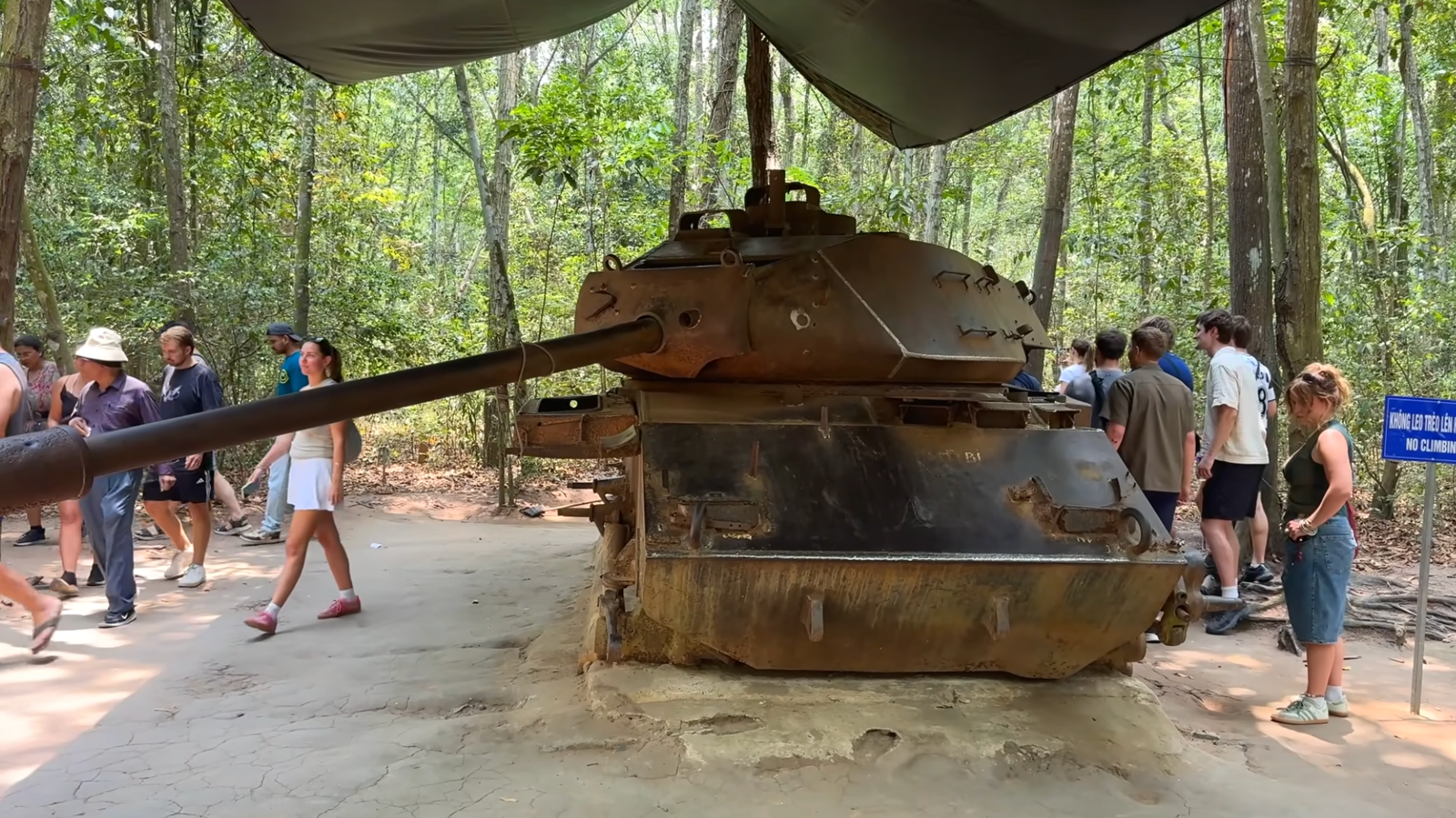
One tank on display here, an American model, was destroyed by a delay mine in 1970, a stark, physical piece of that history sitting right in front of you.
The Shooting Range and Rice Paper Demo
The on-site shooting range lets you fire an AK-47, priced per bullet rather than as a flat package, current rates run roughly 20,000 to 60,000 VND per bullet depending on the operator, with a minimum bullet count typically required. The recoil was far milder than I expected, though I didn’t come close to hitting the target, no prize for me that day. Nearby, a rice paper demonstration shows the whole process, rice flour cooked into liquid form over boiling water, the paper forming from the rising steam, then dried in the sun for 2 to 3 days before packaging. You can eat it dipped in water with a filling, or deep-fried for a crunchier version.
Tapioca comes complimentary with the entry ticket, served here with a peanut, sugar, and salt sauce, a genuinely new combination for me that worked far better than I expected, sweet and salty at once, taking on the flavour of whatever it’s paired with.
Ho Chi Minh City’s Colonial Heritage Walk
Back in the city, the Notre Dame Cathedral, completed in 1880 with materials imported from France, and the Central Post Office, built 1886 to 1891, anchor a proper colonial heritage walk through the city centre. The post office is still genuinely active, a large photo of Ho Chi Minh at its centre, tourists buying and mailing postcards from the same counters that have run for well over a century. Nearby, Book Street offers a calmer contrast to the traffic on either side, a good spot for a coffee mid-walk, and Dong Khoi Street leads toward the river past the Opera House (built 1898), the 145-year-old Continental Hotel (Rabindranath Tagore stayed here in June 1929, a fact recorded in the hotel’s own heritage display), and the Caravelle Hotel opposite a former colonial-era war prison.
Genuinely worth knowing: my State Bank Forex card worked seamlessly here, and Indian food is genuinely easy to find throughout Ho Chi Minh City, Benares Restaurant did a properly good Chole, boiled well with the right balance of masala and coriander, close to what you’d expect back home.
Practical Info at a Glance
| Cu Chi Tunnels entry | ~90,000–135,000 VND depending on site (Ben Dinh or Ben Duoc) |
| Shooting range | ~20,000–60,000 VND per bullet, minimum count usually applies |
| Cu Chi + Mekong Delta in one day | Possible but genuinely hectic; better as two separate days |
| Vegetarian food | Not a concern; Indian restaurants are widely available in Ho Chi Minh City |
Common Questions
Can I combine Cu Chi Tunnels and the Mekong Delta in one day?
You can, but it makes for a genuinely hectic 12 to 13 hour day. If you want to properly enjoy both, splitting them across two days is the better call.
Do I have to crawl through the tunnels?
No, exits appear roughly every 20 metres, so you can stop whenever you’ve had enough. Even the widened tourist tunnel is genuinely tight and hot.
Will I struggle to find vegetarian food in Vietnam?
No, and Indian restaurants specifically are genuinely easy to find in Ho Chi Minh City if you want a familiar meal partway through the trip.
Is the lacquer-painting NGO worth stopping at?
Yes, genuinely. It supports war-disabled artisans directly, and the finished paintings are a level of craftsmanship worth the roughly $50 price on its own merits.
This is the first of ten posts covering a full Vietnam trip, Ho Chi Minh City through to Ninh Binh. The full series:
- Ho Chi Minh City: Inside the Cu Chi Tunnels (this post)
- Independence Palace and the War Remnants Museum
- Hoi An: The Lantern City by Basket Boat
- My Son Sanctuary and a Night on Dragon Bridge
- Ba Na Hills: A French Town in the Clouds
- The Marble Mountains and My Khe Beach
- Hai Van Pass to Hue’s Imperial Citadel
- Hanoi: Train Street and the Hoa Lo Prison
- Ha Long Bay: A Day on a 5-Star Cruise
- Ninh Binh: Boats Rowed by Foot, and a Series Finale
Planning something similar?
Email your route and I’ll reply with honest, first-hand advice, no fluff.
Ask Dhruval →