Asia · Solo Travel
Solo traveller · 19 min read
Region Hanoi, North Vietnam |
Trip length 1 day, Episode 8 of 10 |
Travel style Solo |
Hanoi’s Old Quarter, Train Street, and Hoa Lo Prison together make a genuinely full day, but check the calendar before you plan around Ho Chi Minh Mausoleum specifically, it closes for annual maintenance every year and the 2026 closure runs from September 5 through November 3. If your dates fall in that window, Ba Dinh Square, the Stilt House, and the One Pillar Pagoda nearby are still open regardless.
Hanoi felt like a genuinely different country the moment I landed, cooler air than Central and South Vietnam, a different pace on the streets, and a much heavier concentration of history packed into a small, walkable core. This was North Vietnam, and everything from here to the end of the trip carries that shift.
Ho Chi Minh Mausoleum and the Stilt House He Actually Lived In
Ho Chi Minh’s embalmed body lies on display inside the Mausoleum at Ba Dinh Square, a solemn, heavily regulated experience, silence enforced throughout, no photography inside, guards positioned to keep the whole procession moving and respectful, dress code checked before you’re even let near the entrance. It’s genuinely comparable in tone and setup to Lenin’s Mausoleum in Moscow, the body maintained through the same kind of periodic, specialist preservation work.
One thing worth knowing if you’re planning around this specifically: the Mausoleum closes every year for a genuinely lengthy maintenance period, and the 2026 closure runs from 5 September through 3 November, reopening on 4 November. Even outside that window, it only opens mornings, Tuesday, Wednesday, Thursday, Saturday, and Sunday, closed Monday and Friday entirely. Entry itself is free for everyone.
What genuinely struck me more than the Mausoleum itself was the Stilt House nearby, the actual home Ho Chi Minh chose to live in as head of state, a simple, modest wooden structure on stilts, deliberately unlike the grand, bright-yellow French colonial Presidential Palace sitting close by, which he chose not to live in at all. That decision says something real about the man, a leader who had access to a palace and picked a stilt house instead. The One Pillar Pagoda, a short walk on, is a genuinely striking piece of design, built to resemble a single lotus flower rising out of the water, small in scale but among the most photographed structures in the whole city, its current form dating back centuries even though the surrounding grounds have changed considerably since.
36 Guild Streets and the Legend of Hoan Kiem Lake
Hanoi’s Old Quarter is genuinely built on an idea worth knowing before you wander it, 36 separate streets, each historically dedicated to a single trade, a silver street, a silk street, and so on, guild by guild, a structure that still shapes what you find selling where today even as the exact trades have shifted over the centuries. St. Joseph’s Cathedral, French colonial neo-Gothic in style, still functions as an active church in the middle of all this, a genuinely striking contrast against the surrounding shophouses.
Hoan Kiem Lake anchors the whole area, and it comes with a genuinely well-known founding legend: Emperor Le Loi is said to have been given a magic sword by a golden turtle spirit to defeat foreign invaders, and once victory was won, the turtle reclaimed the sword back into the lake, “Hoan Kiem” itself translating to “Lake of the Returned Sword.” Ngoc Son Temple sits on a small island within the lake, reached by the red-painted The Huc Bridge, genuinely one of the most photographed single spots in Hanoi. Breakfast that morning was Banh Mi, the French-Vietnamese baguette that’s become one of Hanoi’s signature foods, and the vegetarian side of Vietnamese cuisine turned out to be genuinely well developed too, Buddhist “chay” restaurants specifically built around vegetarian eating are common enough that finding one is never a struggle.
Train Street: Coffee Inches From a Moving Train
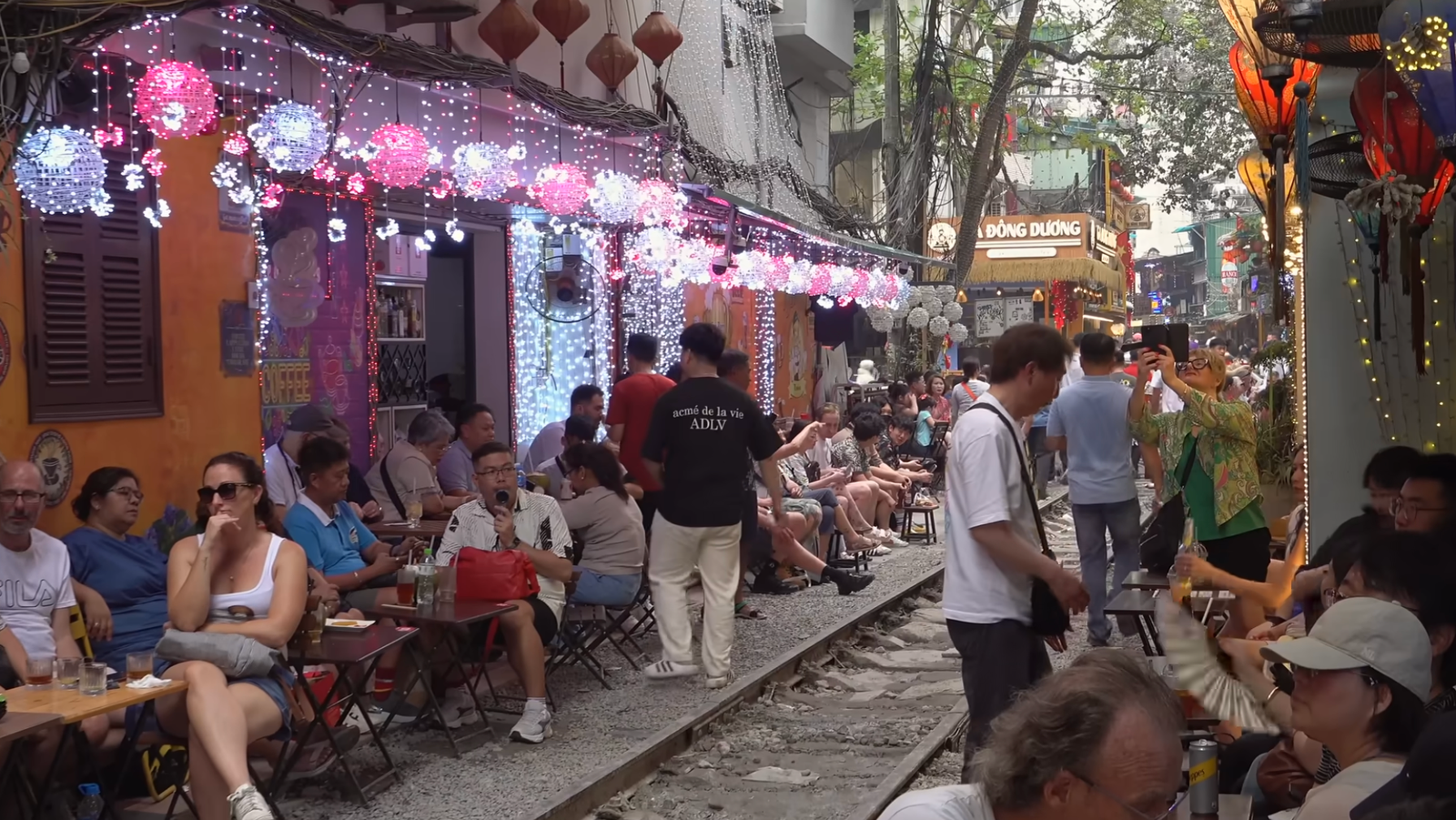
Nothing in Hanoi prepared me for Train Street quite like actually standing on it. This is a genuine residential street with an active railway line running directly through it, close enough to people’s front doors and café tables that there’s barely a metre of clearance on either side. Twice a day, a real train comes through, and everyone, residents and tourists both, clears the track and presses back against the walls and shopfronts while it passes. Cafés along the street have built their entire business around this exact moment, tables set specifically so you’re sipping a coffee as the train rolls past close enough to feel the draft of it. It’s genuinely one of the strangest, most memorable things I’ve done on this whole trip, equal parts unsettling and impossible to look away from.
Hoa Lo Prison: A French Guillotine and a Sardonic Nickname
Hoa Lo Prison, entry roughly 30,000 to 50,000 VND depending on current pricing, carries two entirely different, equally heavy layers of history under one roof. The French built it in 1896 specifically to hold Vietnamese political prisoners and revolutionaries fighting colonial rule, and the conditions on display here are genuinely brutal, an actual guillotine, cramped communal cells, ankle shackles bolted to concrete sleeping platforms, and solitary confinement cells built deliberately too small to lie down in.
The second layer came decades later, when the same prison held American pilots as prisoners of war. “Hanoi Hilton,” the nickname most people know it by today, wasn’t a compliment, American POWs coined it sardonically, mocking just how far the reality was from anything resembling a hotel. The museum’s own framing today leans toward emphasising decent treatment of American prisoners, and while individual accounts genuinely vary, including former POWs who’ve returned since and spoken about their time there, it’s worth holding that against the nickname’s own ironic origin rather than taking either extreme as the full picture. What isn’t in question is the brutality of the earlier French colonial period, documented here in unflinching detail.
Practical Info at a Glance
| Ho Chi Minh Mausoleum 2026 closure | 5 September – 3 November; reopens 4 November |
| Mausoleum visiting days | Tue, Wed, Thu, Sat, Sun mornings only; free entry |
| Hoa Lo Prison entry | ~30,000–50,000 VND depending on current pricing |
| Train Street | Trains pass twice daily; check current timing locally before visiting |
Common Questions
Is Ho Chi Minh Mausoleum open right now?
Check the current year’s dates before you plan around it. In 2026, it’s closed for annual maintenance from 5 September through 3 November. The surrounding complex, including the Stilt House and One Pillar Pagoda, stays open regardless.
Why is it called “Train Street”?
An active railway line runs directly through a narrow residential street in the Old Quarter, close enough to cafés and homes that everyone has to clear the track when a train passes, twice a day.
Why is Hoa Lo Prison called the “Hanoi Hilton”?
American POWs coined the name sardonically during the Vietnam War, mocking how far conditions were from anything resembling a hotel. It wasn’t originally meant as a compliment.
Why did Ho Chi Minh live in a stilt house instead of a palace?
A deliberate personal choice reflecting his own modesty, even with the grander Presidential Palace available right next door, which he chose not to occupy at all.
This is the eighth of ten posts covering a full Vietnam trip. The full series:
- Crawling the Cu Chi Tunnels and Firing an AK-47
- 604,481 Soldiers and a War That Ended at 11:30 AM
- Hoi An by Basket Boat, in a Town That Floods Every November
- The Shiva Temple India Is Rebuilding in Vietnam
- A Golden Bridge Held Up by Two Stone Hands
- Watching a Mountain Become a Buddha in Da Nang
- An Imperial Citadel Still Scarred From 1968
- Hanoi: A Train, a Closed Mausoleum, and a Sardonic Nickname (this post)
- Ha Long Bay: A Day on a 5-Star Cruise
- Ninh Binh: Boats Rowed by Foot, and a Series Finale
Planning something similar?
Email your route and I’ll reply with honest, first-hand advice, no fluff.
Ask Dhruval →